How to Launch on Product Hunt: A Solo Founder's Checklist (Week Before to Day After)
Most Product Hunt guides were written when every launch reached the homepage. Now about 1 in 23 is featured, and Product Hunt asks you not to request upvotes at all. Here is what still works for a solo founder, from four weeks out to the morning after.

To launch on Product Hunt, post it yourself from a personal account at 12:01am Pacific on a day you are ready. Prepare a short tagline, a description up to 260 characters, a 240 x 240 thumbnail and two or more 1270 x 760 images. Ask your own people to visit and comment, never to upvote, and answer every comment for 24 hours.
Product Hunt still works for a new product, but not the way the old guides say. Most launches are never featured on the homepage now, votes from strangers you messaged count for little, and Product Hunt's own launch page says you should not ask people to upvote at all. What does work is a finished product, a clean page, a short list of people who already care, and a maker who answers every comment for 24 hours.
This is the checklist for a solo founder or a two-person team: what to do four weeks out, the week before, hour by hour on the day, and the day after. The rules and sizes below come from Product Hunt's own launch and help pages, checked on 29 October 2026; where we rely on another source, we say so. If you want a first draft written for you, the Astarii launch and directories helper drafts a Product Hunt launch for your approval and never posts it on its own. Pair the launch with the 45 startup directories we checked, and see the guide to AI agents for small business for the other jobs you can hand off.
The short version
- Post it yourself. Product Hunt says there is "no discernible advantage" to a third-party hunter. Use your personal account; company accounts cannot post.
- Launch at 12:01am Pacific on a day you are ready for. Product Hunt days run midnight to midnight Pacific, so an early start gives you the full 24 hours.
- Get the page right: a plain name, a short tagline, a description up to 260 characters, a 240 x 240 thumbnail, at least two 1270 x 760 gallery images and an optional YouTube demo.
- Ask people to visit and comment, never to upvote. That is Product Hunt's stated rule, and vote rings get launches buried.
- Answer every comment the same day. It is the one thing nobody can do for you, and it is what visitors read.
- Expect not to be featured. In the 30 days to 29 October 2026, one tracker counted 881 featured launches out of 19,979, about 1 in 23. Plan the launch so it pays off anyway.
What a Product Hunt launch gets you in 2026
When you post, your launch goes up for the day. Product Hunt's team then chooses which launches to feature on the homepage, where most of the traffic is. Everything else stays reachable from the full list of the day's launches, but far fewer people scroll there.
The numbers are humbling. The Hunted Space tracker, which counts launches and features every day, showed 19,979 launches and 881 features in the 30 days to 29 October 2026. Its all-time feature rate is 22.7%, so featuring has become much rarer than it used to be. Nobody outside Product Hunt knows the exact criteria. Product Hunt's newsletter editor has written that they look for products that do something unique, with images that show the product well, which matches what founders who got featured report.
So treat a launch as three things at once, and judge it on all three:
| What you get | If featured | If not featured | Worth it because |
|---|---|---|---|
| Visitors on the day | Hundreds to thousands, mostly makers and early adopters | Mostly the people you told yourself | A spike you can measure with a tracking tag |
| Feedback | Dozens of comments from strangers | A handful, often sharper | Real questions show what your page fails to explain |
| A permanent page | Yes, with a badge if you place in the top five | Yes | It ranks for your brand name and is cited by AI assistants |
| A reason to email your list | Yes | Yes | "We launched today" is news, and news gets opened |
| Sign-ups | Often a short spike, then a tail | Small | Only if the landing page converts; fix that first |
Four weeks before: account, audience, date
Most of a launch is decided before the day. Four weeks gives you time to do the dull parts without rushing.
- Set up your own account properly. Use your real name and photo, a one-line bio that says what you build, and a link to your site. Product Hunt does not allow company accounts to post, and new accounts have to finish onboarding first.
- Be a normal member for a few weeks. Try products in your category, leave useful comments, follow the makers you respect. An account that only shows up on launch day looks like what it is.
- Check you have not been posted already. Search for your product name. If someone else has hunted it, Product Hunt says you can relaunch later or contact them for help.
- Build a short list of people who care. Beta users, customers, newsletter readers, friends who actually use the product. Twenty to fifty real people beat five hundred strangers. Put them in a sheet with how you know them and how you will reach them.
- Pick a date. Product Hunt's own advice is the day you are most prepared. Weekdays bring more visitors and more competition; weekends are quieter on both counts. Avoid days when a big launch in your category is announced, and avoid your own busy days, because you will be on comments for 24 hours.
- Fix the landing page. Visitors from Product Hunt land on your site expecting to try something within a minute. Make the first screen say what it does, who it suits and how to start free, if there is a free way to start.
The week before: build the page
Product Hunt lets you save a draft and schedule a launch for a future day, so build the page early and look at it fresh the next morning. Here is every field, with the spec from Product Hunt's posting guide.
| Field | Spec | How to get it right |
|---|---|---|
| Name | Product name only, no description or emoji unless they are part of the name | "Acme", not "Acme: the AI that does X" |
| Tagline | Very short; guides put the limit at 60 characters | Say the outcome in plain words. Write five, read them aloud, keep the clearest |
| Description | Up to 260 characters | Who it is for, what it does, one detail that is unusual, how to start |
| Thumbnail | Square, 240 x 240 recommended; GIFs under 3MB and not flashy | Your logo on a plain background reads best at small sizes |
| Gallery | 1270 x 760 recommended; at least 2 images before it shows | 3 to 5 images: the main screen, one per key job, a short caption on each |
| Video | Optional; YouTube only, full URL, not private | Under two minutes, showing the product doing one real job |
| Topics | Only a few that fit best | Pick the topics your buyers browse, not the busiest ones |
| First comment | Posted by you as soon as it goes live | Why you built it, who it is for, what is free, what you want feedback on |
The first comment does more work than any other field. Visitors read it before they try the product. Keep it to five short paragraphs: the problem in one line, why existing tools did not fix it for you, what the product does today, what it costs, and the one question you most want answered. End with a real question, such as "what would stop you using this every week?", because questions get replies and replies are the launch.
Prepare three more things the same week:
- A tracking tag on your link (for example
?ref=producthunt) so your analytics separate launch visitors from everyone else. - Two short messages for your list: one for the morning of the launch, one thank-you for the day after. Both invite people to visit and comment. Neither asks for an upvote.
- A launch-day plan with blocks of time for replies, written into your calendar, and someone else covering anything you would normally do that day.
Do you need a hunter?
No. This is the question every founder asks, and Product Hunt answers it on its own launch page: makers should hunt their own products, and there is "no discernible advantage" to using a third-party hunter. Posting yourself also keeps control of the page, the first comment and the timing. You will see people selling "top hunter" services; you can skip them. The same goes for paid upvote or "launch support" packages, which risk getting your launch buried.
Launch day, hour by hour (Pacific time)
Product Hunt's site runs on 24-hour days in Pacific time, and posts go live at 12:01am. If you live in Europe, that is breakfast time; in the US it is a late night, so plan your sleep around it.
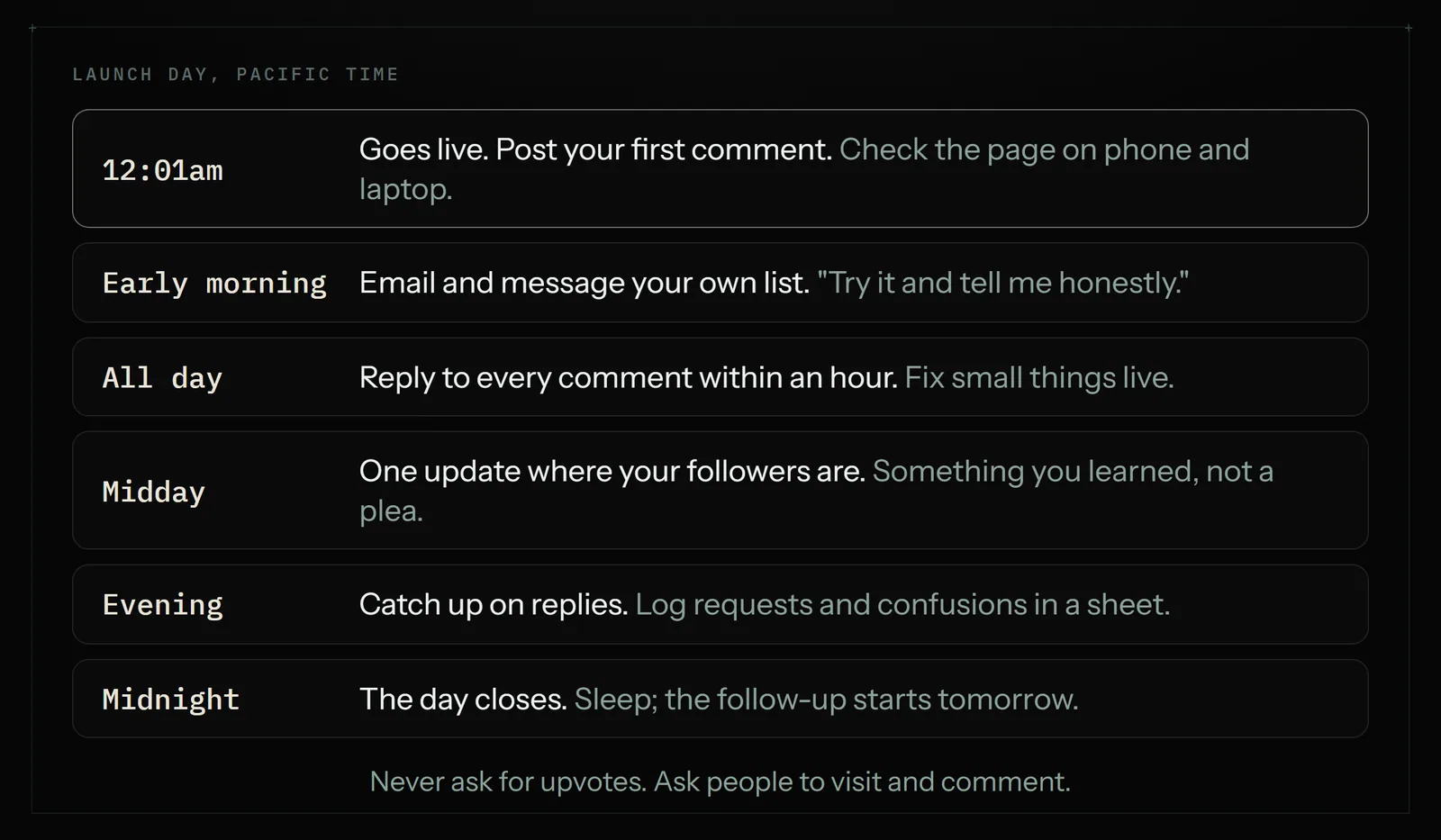
- 12:01am: go live and post your first comment. Check the page on your phone and on a laptop. Fix any typo now, while few people have seen it.
- Early morning: tell your own people. Send the email and post where your followers already are. The message is "we launched today, here is the link, I would love your honest take in the comments." Personal notes to the people on your list do better than one blast.
- All day: reply to every comment within an hour. Thank people by name, answer the question asked, and fix small things live when you can ("good catch, fixed"). Product Hunt shows maker replies, and a page full of them reads as a product someone cares about.
- Midday: post once more where it fits. One update on X or LinkedIn with something you learned from the comments so far. Not a second "please support us".
- Evening: catch up on anything you missed and note every feature request and confusion in a sheet.
- Midnight: the day closes. Results are what they are. Sleep.
The day after: keep what the launch brought
The launch spike fades in a day or two. The work you do the morning after decides whether it was worth it.
- Send the thank-you message to everyone who visited or commented, with one thing you are changing because of them.
- Read your analytics by tag. How many visits came from Product Hunt, how many signed up, how many came back. Write the numbers down; you will want them for the next launch.
- Turn comments into a list. Group feature requests, confusions and bugs. The confusions are the most valuable: they are what your landing page fails to say.
- Use the page. Link to it from your site if it helps visitors trust you, and add a badge if you placed. AI assistants read these pages when people ask about tools in your category.
- Start the directories. The week after a launch is a good time to begin listing on the startup directories, two a day, using the same kit.
- Plan the next one. Product Hunt lets you relaunch "as often as you have new significant product iterations available." A big new feature in three to six months is a real second launch.
Mistakes that sink small launches
- Launching before people can try it. A waitlist page gets few comments and little goodwill.
- A clever tagline nobody understands. If a stranger can't say what you do after reading it, rewrite it.
- Asking for upvotes. It breaks the stated rule and it reads as desperate in the comments.
- Disappearing after the first hour. Unanswered comments are the clearest signal that nobody is home.
- No tracking. Without a tagged link you can't tell whether the launch did anything, and you can't improve the next one.
- Treating it as the whole plan. One day of attention does not replace the slow work: replies in communities, directories, a newsletter, search.
Where an AI helper fits (and where it doesn't)
A launch is part writing, part clicking, part being present. Software can help with the first two; the third is yours.
The Astarii launch and directories helper drafts a Product Hunt launch for your approval: tagline options, the description, the first comment and gallery captions, written from a launch doc you keep. Nothing goes live until you approve it, and you post it from your own account. After the launch it lists your product on startup directories a couple a day, and task memory means it never submits to the same directory twice. When a site texts a sign-in code, it pauses and asks you, then carries on. Saved passwords are encrypted in your browser and never shown to the AI.
Where it is not the right tool:
- Replying to comments on the day. People want the maker, and they can tell. Do this yourself.
- Getting votes. It won't message strangers or ask for upvotes, and you shouldn't either.
- Taste. Which screenshot leads, what the product is really for, whether you are ready: those are your calls.
- One-off writing on a free plan. If all you need is a tagline brainstorm, a chat assistant does that for free. A helper earns its cost on the repeated work around a launch, like directory listings and weekly follow-ups.
Astarii has a free trial of 3 runs of up to 15 minutes each with no card, and plans start at $29.99 a month on the pricing page. It works in the cloud, so a directory run carries on with your laptop closed.
The checklist to copy
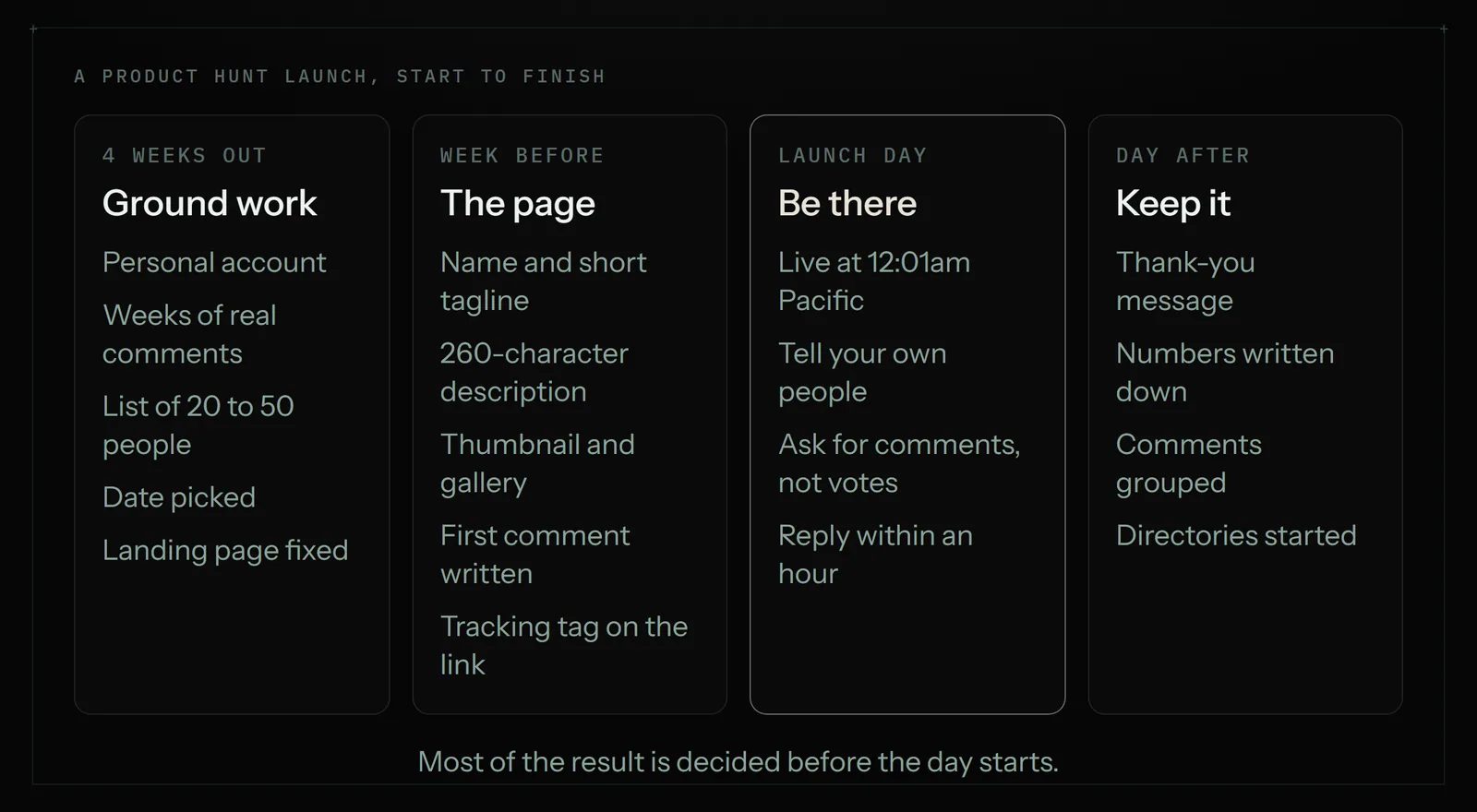
- Four weeks out: personal account set up, a few weeks of real comments, name search done, list of 20 to 50 people in a sheet, date picked, landing page fixed.
- Week before: name, tagline, 260-character description, 240 x 240 thumbnail, 3 to 5 gallery images at 1270 x 760, optional YouTube demo, topics, first comment, tracking tag, two messages, calendar blocked.
- Launch day: live at 12:01am Pacific, first comment posted, morning email to your list asking for visits and comments, every comment answered within an hour, notes in a sheet.
- Day after: thank-you sent, numbers recorded, comments grouped, page linked, directories started, next launch pencilled in.
Want the drafting and the directory clicking done for you? Start with the launch and directories helper, or read how to set up your first Astari.
Say it to an Astari
These are instructions you can give an Astari, word for word. It does the work in a browser, on a schedule if you want one, and asks you before anything goes live.
Questions
How do I launch on Product Hunt?
Set up a personal account, build your launch page as a draft (name, tagline, description up to 260 characters, thumbnail, at least two gallery images), schedule it for 12:01am Pacific, post a first comment as soon as it goes live, tell your own people, and reply to every comment until the day ends at midnight Pacific.
What time should I launch on Product Hunt?
12:01am Pacific time. Product Hunt days run midnight to midnight Pacific, so posting just after midnight gives your launch the full 24 hours. Product Hunt recommends that time for makers who have no other constraint.
Do I need a hunter to launch on Product Hunt?
No. Product Hunt says makers should hunt their own products and that there is no discernible advantage to using a third-party hunter. Posting yourself also keeps control of the page and timing.
Can I ask people to upvote my Product Hunt launch?
No. Product Hunt's rule is that you cannot ask people directly to upvote. Ask them to visit and leave a comment instead. Vote swapping and messaging strangers can get a launch pushed down the list.
What image sizes does Product Hunt use?
Product Hunt recommends a square 240 x 240 thumbnail, with GIFs under 3MB, and 1270 x 760 gallery images. The gallery needs at least two images before it shows. Videos must be public YouTube links.
How many Product Hunt launches get featured?
A minority. The Hunted Space tracker counted 881 featured launches out of 19,979 in the 30 days to 29 October 2026, about 1 in 23, and an all-time feature rate of 22.7%. Product Hunt's team chooses which launches to feature.
Can I launch on Product Hunt more than once?
Yes. Product Hunt lets you relaunch as often as you have significant new product iterations. A major new feature a few months after your first launch is a fair reason for a second one.
Can an AI write my Product Hunt launch?
It can draft it. The Astarii launch and directories helper drafts a Product Hunt launch for your approval, including tagline options, description and first comment, and lists your product on startup directories a couple a day. You post the launch and reply to comments yourself.
filed under Marketing