Virtual Assistant vs AI Agent for a Small Business: Cost, Tasks, and When to Use Each
A virtual assistant is a person you pay by the hour. An AI agent is software you pay by the minute. Most small businesses need a bit of both, and the trick is knowing which tasks go where.

A virtual assistant is a remote person, typically $10 to $20 an hour on marketplaces or $36 to $39 an hour at a US agency, best for phone calls, customer care and judgment calls. An AI agent such as Astarii is software that does repeated browser and inbox work on a schedule, from $29.99 a month. Most small businesses do best by splitting the list between them.
Most owners who search for a virtual assistant aren't looking for a person so much as a way out of a list. Check the orders. Copy the invoices into the sheet. Chase the two clients who haven't paid. Reply to the supplier. Update the prices on the marketplace. Some of that list needs a human. A surprising amount of it doesn't, and in 2026 the honest question is which half is which.
This guide compares a virtual assistant (a remote person you pay by the hour) with an AI agent (software that does multi-step work in a browser), task by task, with real prices. It ends with a simple way to split your list between the two. If agents are new to you, the guide to AI agents for small business covers the basics. If you want to see what an agent costs first, the Astarii pricing page has the plans.
The difference in one paragraph
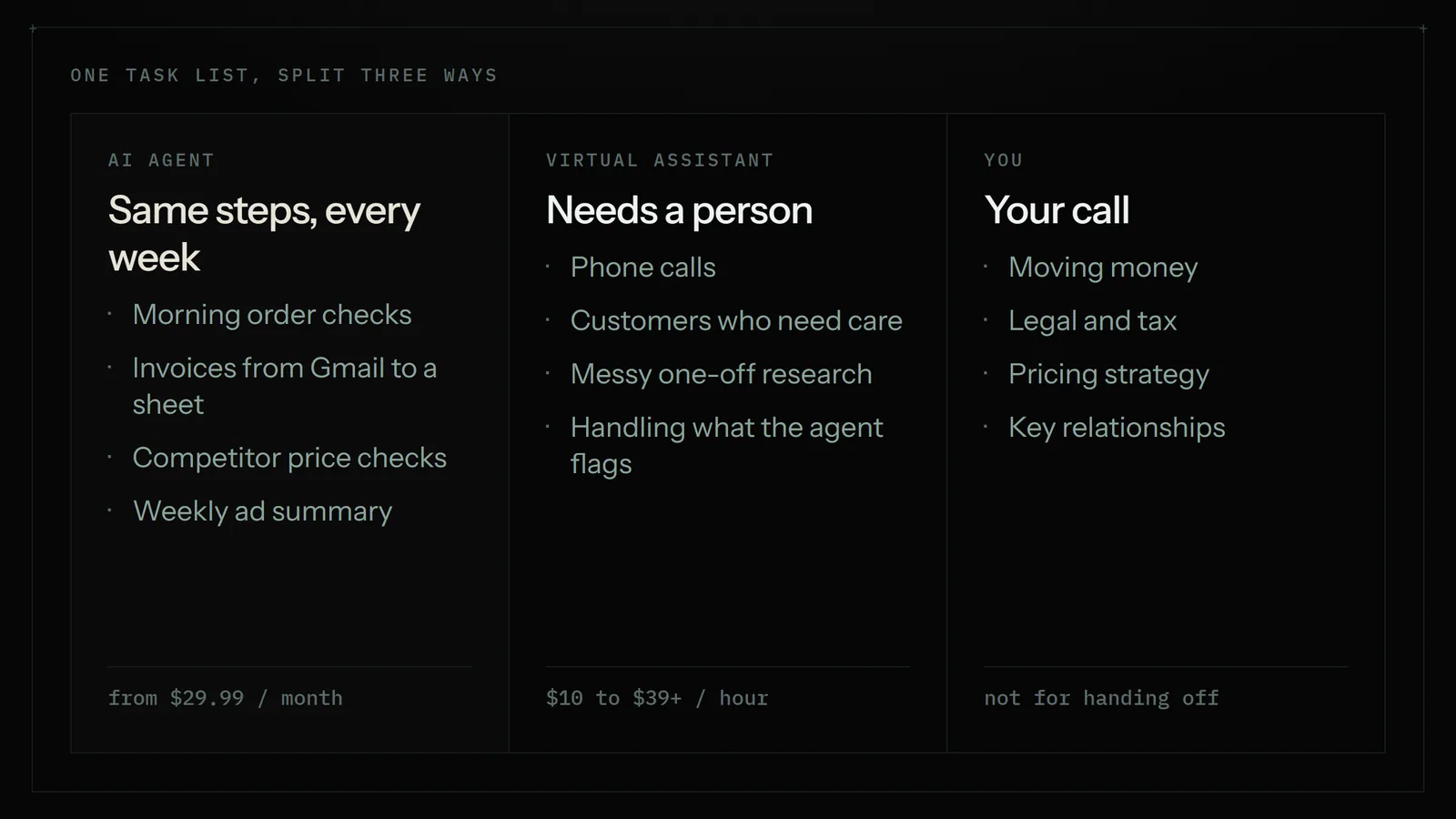
A virtual assistant is a person. They work remotely, usually through a marketplace like Upwork or an agency like Time etc, and they bring judgment, a voice on the phone and the ability to handle something they've never seen before. An AI agent is software. You describe a job in plain English, it opens websites, signs in, fills in forms, sends emails and updates spreadsheets, then reports what it did. It runs on a schedule without being reminded, it costs a fraction of an hour of a person's time, and it is only as good as the instruction and the sites it works on. Neither is a better version of the other. They are good at different parts of the same list.
Side by side: what each one is like to work with
| Virtual assistant | AI agent (Astarii) | |
|---|---|---|
| What you pay for | Hours of a person's time | Minutes of run time |
| Typical price | About $10 to $20 an hour on marketplaces; $36 to $39 an hour at a US agency like Time etc | $29.99, $49.99 or $99.99 a month; 3 free runs to try |
| Minimum commitment | Often 10 hours a month at agencies | Month to month |
| Getting started | Find, interview, onboard, share logins | Describe the job or show it once |
| Phone calls and live chat | Yes | No |
| Works at 7:30 every weekday without a reminder | If their hours allow | Yes, on a schedule, with your computer off |
| New, messy, one-off problems | Strong | Weaker; asks you when it needs a decision |
| Same task, same way, every week | Good, but people get bored and skip steps | Strong; task memory stops repeats |
| Your passwords | The person sees them, or uses a password manager | Encrypted in your browser before storage, never shown to the AI |
| When they're away | Holidays, sick days, a replacement to train | Runs as long as minutes remain on the plan |
Two lines in that table matter more than the rest. A person handles the unfamiliar, and software handles the repetitive without drifting. Almost every decision below comes back to those two facts.
What a virtual assistant really costs
VA pricing varies more than almost any other small-business service, because "virtual assistant" covers everyone from a beginner in a lower-cost country to a US executive assistant with ten years in the job.
- Freelance marketplaces. Rate guides put general virtual assistants on Upwork at roughly $10 to $20 an hour, rising to $35 to $75 or more for specialists such as bookkeepers or executive support. The marketplace also adds a client fee on top.
- US agencies. Time etc publishes its plans: $390 a month for 10 hours ($39 an hour), $760 for 20, $1,480 for 40 and $2,160 for 60 hours ($36 an hour). The matching and replacement are part of what you're paying for.
- Premium agencies. Some don't publish rates at all and quote after a sales call. Third-party reviews put several of them in the $40 to $65 an hour range.
The hourly rate is only part of it. Onboarding takes your time: explaining the job, recording a walkthrough, answering questions in week one. Freelancers can leave, and a replacement means doing it again. None of that is a reason not to hire a VA. It's a reason to hand them the work that actually needs a person.
What an AI agent costs
Astarii is priced in minutes of agent run time, month to month, in US dollars:
- Free trial: 3 runs of up to 15 minutes each, no card needed.
- Pro, $29.99 a month: 900 cloud minutes plus 800 browser minutes, runs up to 45 minutes each.
- Max, $49.99 a month: 1,600 cloud minutes plus 2,000 browser minutes, two runs at once.
- Ultra, $99.99 a month: 3,400 cloud minutes plus 4,500 browser minutes, four runs at once.
Cloud minutes are runs in Astarii's own browser, so your laptop can be closed. Browser minutes are runs in your own Chrome or Brave through the extension. Minutes are a run's real length, rounded up to the minute, and pools reset on the 1st. If you run out, 250 extra cloud minutes cost $9.99. Full details are on the pricing page.
Other agent tools price differently, some by task and some by credits. Compare them on the same job, not the headline number.
A worked example: one shop's week
Take a small online shop with a part-time owner. Their weekly admin, timed honestly:
| Task | Time a week | Who should do it |
|---|---|---|
| Check new orders each morning and flag problems | 50 min | Agent |
| Copy supplier invoices from Gmail into the sheet | 40 min | Agent |
| Check five competitors' prices | 45 min | Agent |
| Weekly ad results into a summary email | 30 min | Agent |
| Answer customer messages that need a real reply | 1 hr 15 min | VA, or you |
| Phone the courier about lost parcels | 45 min | VA |
| Sort out a wholesale enquiry with odd terms | 1 hr | You |
The first four rows, about 2 hours 45 minutes a week, are the same steps every time on websites the owner already logs into. Handed to a VA, that's roughly 12 hours a month, more than the 10-hour Time etc plan covers on its own. Handed to an agent, it fits comfortably inside a $29.99 Pro plan if each run takes a few minutes. Agent run time isn't the same as human time; a run can be quicker or slower than a person on the same site, so try it on the free runs before you count on a number.
The last three rows are where a person earns their rate. Phone calls, customers who are upset, and enquiries that don't fit a template all need judgment. The message replies and the courier calls come to about 2 hours a week, under 9 hours a month, so a VA on the 10-hour plan at $390 covers them. The owner keeps the wholesale deal.
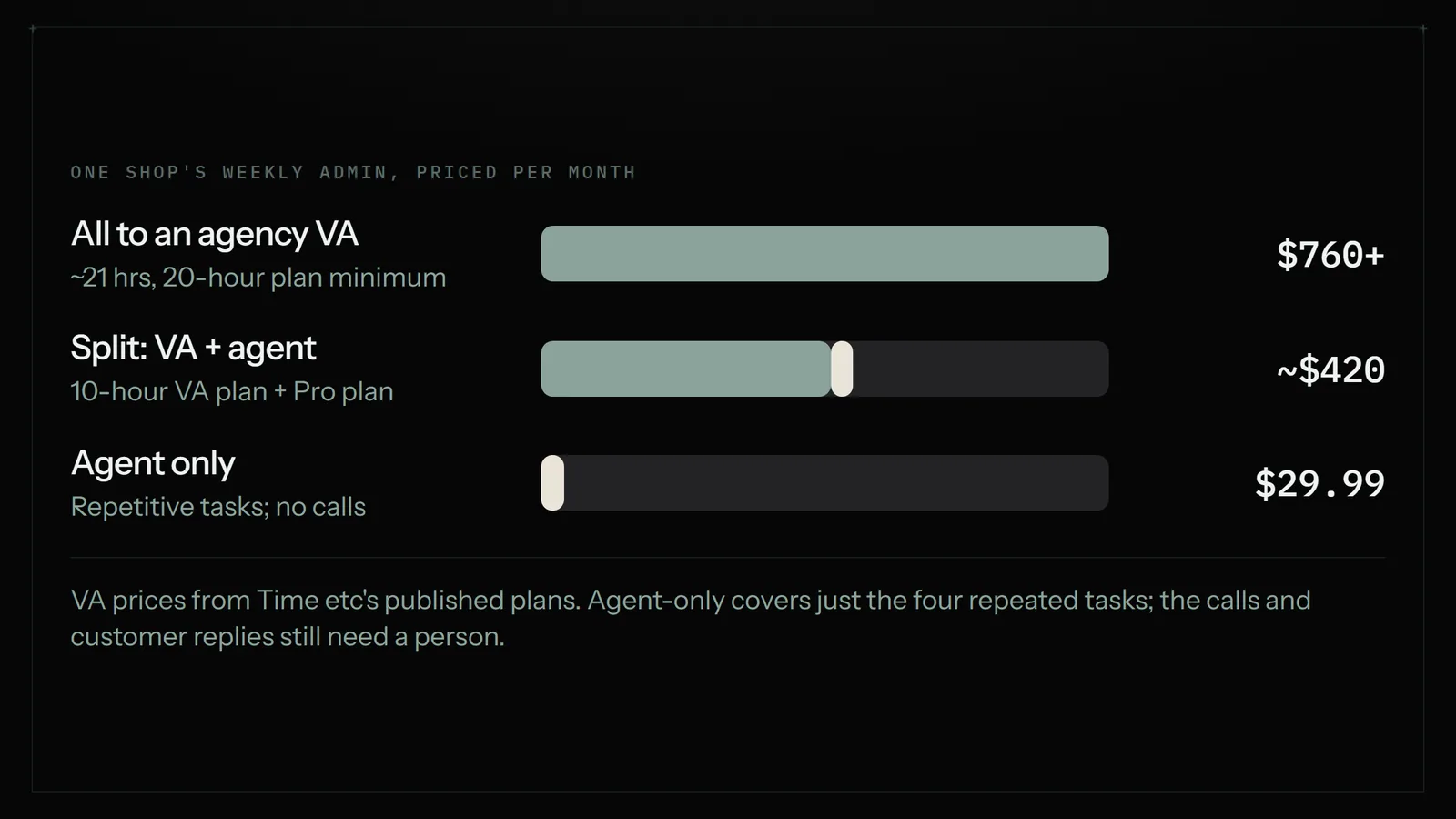
Together that's about $420 a month for both. Handing the whole list to an agency VA instead is about 21 hours a month, which means at least the $760 20-hour plan with no slack, and likely more. Your numbers will differ. The pattern usually holds.
Jobs to give an AI agent
An agent is the better pick when the job is rule-based, repeats on a schedule and happens on websites or in Gmail, Outlook, Google Sheets, Docs, Calendar or Drive. From what Astarii does today:
- Morning checks. Read new orders, a supplier portal or a stock page and email you what changed.
- Data entry between sites and sheets. Copy rows out of a portal you log into and add only the new ones. See automating data entry into Google Sheets.
- Inbox to spreadsheet. Move invoices from Gmail into a sheet every Friday, following "View invoice" links where needed. The Gmail invoices guide walks through it.
- Etsy shop work. The Etsy Manager reads orders and listings and proposes price or description changes. Every change to the live shop waits for your approval.
- Google Ads. The Google Ads Manager reads results, researches keywords and drafts campaigns. Everything it creates starts paused, so nothing spends until you turn it on.
- Posting and replies. Useful replies on X and Reddit in your voice, within sensible limits.
A scheduled Astari has task memory, so it never does the same item twice: it won't re-email a lead or log an invoice that's already in the sheet. When a site texts a sign-in code, or something needs your decision, it pauses and asks, then carries on from where it stopped.
Jobs to give a virtual assistant
A person is the better pick when the job needs a voice, a relationship or a judgment call that changes every time:
- Phone work. Calling suppliers, couriers, venues or customers. An agent doesn't make calls.
- Customer messages that need care. Complaints, refunds you've agreed to, anything where tone matters more than speed.
- Messy research. "Find us three venues for a pop-up in March under $500" involves trade-offs and follow-up questions.
- Calendar diplomacy. Juggling meetings with people who reply slowly and change their minds.
- Supervising the agent. A good VA can own the agent's instructions, read its reports and handle the exceptions it flags. That pairing is often the best of both.
Jobs to keep for yourself
Some things shouldn't go to either. Moving money, signing anything legal or tax-related, pricing strategy, and the customer relationships your business depends on stay with you. Agents and assistants can prepare the work: draft the reply, list the overdue invoices, propose the new prices. The decision is yours. Astarii is built that way on purpose: changes to a live shop are proposed first, ad campaigns start paused, and sign-in codes pause the run for you.
How to split your list in 30 minutes
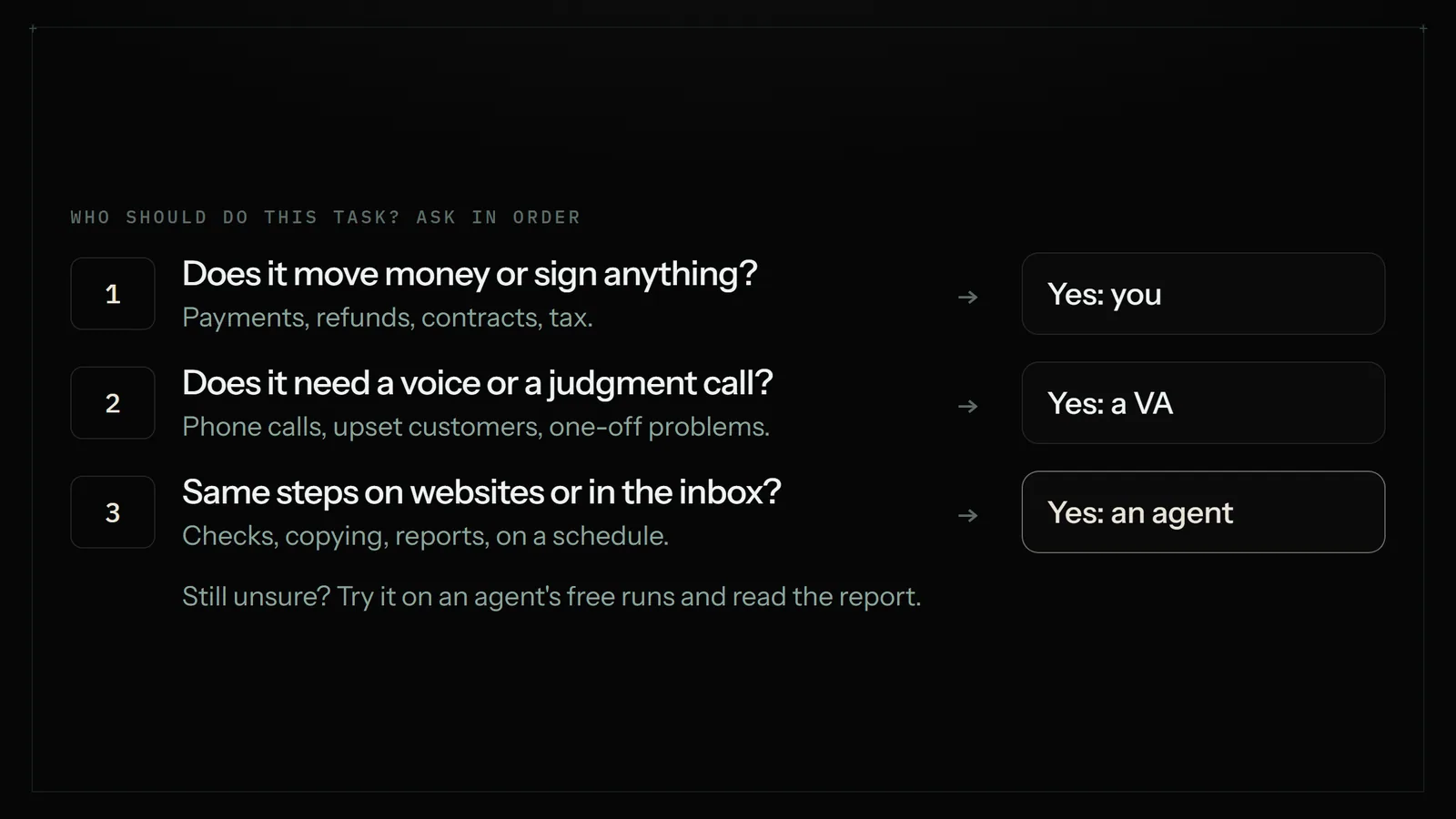
- Write down a normal week. Every repeated task, roughly how long it takes and where it happens (a website, Gmail, the phone).
- Mark the phone and judgment tasks. Anything involving a call, an upset person or a decision that changes each time goes to the VA column or yours.
- Mark the money and legal tasks. Those stay with you, full stop.
- Everything left is agent work. Same steps, same sites, on a schedule.
- Try the biggest agent task first. Describe it in plain English on the free runs and read the report it sends back. See your first Astari.
- Schedule it. Every weekday at 7:30, every Friday, three times a day: whatever matches the job. See scheduling.
- Size the VA hours last. Once the repetitive work is gone, you'll often find you need 10 hours of a person a month, not 40.
Where an agent falls short
Being honest about this is what makes the split work. An agent won't pick up the phone. It won't notice that a regular customer sounds unhappy in a way that isn't in the words. It can struggle with websites that change their layout often or block automated visitors, and a vague instruction gets a vague result. If most of your list is calls, relationships and judgment, a VA is the right hire and an agent adds little. If most of it is the same clicks every week, a VA is an expensive way to do it.
There is also a middle ground: plenty of VAs now use AI tools themselves. If you already have a good assistant, handing them an agent to run the repetitive half is often a better move than replacing anyone.
The bottom line
Hire a virtual assistant for the work that needs a person: calls, care and judgment. Use an AI agent for the work that needs consistency: the same steps on the same sites, on a schedule, with a report at the end. Keep money, legal and strategy for yourself. For most small businesses that means a smaller VA contract than you expected, plus an agent doing the morning checks and the Friday spreadsheet.
To try the agent half, start with 3 free runs, no card, from the Astarii home page, or compare plans on the pricing page. The ready-made Astarii for Etsy, Google Ads, inboxes and more are on the apps page.
Say it to an Astari
These are instructions you can give an Astari, word for word. It does the work in a browser, on a schedule if you want one, and asks you before anything goes live.
Questions
Is an AI agent cheaper than a virtual assistant?
For repetitive online work, usually yes. Astarii plans are $29.99, $49.99 or $99.99 a month, measured in minutes of run time, while agency VAs like Time etc start at $390 a month for 10 hours. For phone calls and judgment-heavy work, a VA is the right spend because an agent can't do it.
How much does a virtual assistant cost for a small business?
Rate guides put general VAs on freelance marketplaces at about $10 to $20 an hour, with specialists at $35 to $75 or more. US agencies charge more: Time etc publishes $390 a month for 10 hours, up to $2,160 for 60 hours. Add your onboarding time to the bill.
Can an AI agent replace a virtual assistant?
For part of the job. An agent can take over the same-steps-every-week work: order checks, data entry, invoices into a sheet, price checks, ad summaries. It can't make phone calls or handle a sensitive customer, so most businesses keep a smaller VA contract alongside it.
What tasks should I give a virtual assistant instead of AI?
Phone calls, upset customers, messy research with trade-offs, scheduling with people who reply slowly, and anything that needs a judgment call that changes each time. A VA can also supervise an agent and handle the exceptions it flags.
Is it safe to give an AI agent or a VA my passwords?
With a VA, the person sees your logins unless you use a password manager that hides them. With Astarii, saved passwords are encrypted in your browser before they're stored and are never shown to the AI. When a site texts a sign-in code, the run pauses and asks you.
Will an AI agent make changes or spend money without asking?
Not the way Astarii is set up. The Etsy Manager proposes every change to your live shop and waits for approval, and campaigns the Google Ads Manager drafts start paused. Moving money is a job to keep for yourself either way.
Do I need to know how to code to use an AI agent?
No. With Astarii you describe the job in plain English, or show it once, and set a schedule. There's nothing to install to start, and the first 3 runs of up to 15 minutes are free with no card.
Can a virtual assistant use an AI agent?
Yes, and it's often the best setup. The VA writes and adjusts the agent's instructions, reads its reports and deals with what it flags, so their paid hours go on work that needs a person.
filed under AI agents explained