ChatGPT for Small Business: What It Does Well and Where You Need an Agent That Clicks
ChatGPT is the AI tool most owners already use, and for writing and thinking it is hard to beat. Here is what it does well, what each plan costs, and the point where a job needs an agent that clicks instead.

ChatGPT suits a small business for writing, reading documents, analysing exports and planning. Plus is $20 a month for one person; Business is $25 per user a month, or $20 billed yearly, with two seats minimum. For the same online steps every day on sites behind a login, a scheduled browser agent such as Astarii, from $29.99 a month, fits better. Many owners use both.
Most small-business owners already have ChatGPT open in a tab. It writes the awkward email, explains the tax letter, tidies the product description and turns a messy list into a plan. That is real time saved, and for a lot of businesses it is the only AI tool they need.
The trouble starts when you want the same online job done every day without you: sign in to a supplier portal, copy the new orders into a sheet, email the customers who haven't paid. ChatGPT has grown towards that in 2026, with ChatGPT Work, a cloud browser and scheduled tasks, but it still works best as a thinking and writing partner. This guide covers what it does well, what each plan costs, where it runs out, and when a scheduled browser agent such as Astarii fits better. For the wider picture, start with the guide to AI agents for small business.
The short version
- Use ChatGPT for words and thinking. Drafting emails and posts, answering questions about a document, summarising long threads, making sense of a spreadsheet you paste in, planning a launch or a price change. It is fast, cheap and good at this.
- Pick the plan by how much you lean on it. Free is fine for occasional use. Plus is $20 a month and suits one person who uses it daily. Business is $25 per user a month, or $20 billed yearly, with a two-seat minimum, and adds a shared workspace and admin controls.
- Use an agent that clicks for the repeated online work. When the job is the same steps on websites behind a login, every weekday or every Friday, a scheduled browser agent does it without you, remembers what it has already done, and reports back.
- Many owners use both. Astarii can think with your own ChatGPT plan if you link it, so you don't have to choose one or the other.
What ChatGPT does well for a small business
The common thread in the jobs below is that you are in the loop. You ask, it answers, you read the answer and decide. That covers a lot of a small business's week.
Writing you would otherwise put off
Customer replies, refund-refusal emails that stay polite, supplier follow-ups, job ads, the "about us" page you have meant to rewrite for two years. Give it the facts and the tone ("short, friendly, no exclamation marks") and edit what comes back. For product listings, paste the details and ask for three versions of the title and the first paragraph, then pick one.
Reading so you don't have to
Paste a contract, a lease clause, a long email thread or a platform policy update and ask what it means for you, what you have to do, and by when. It is good at turning ten pages into five bullet points. Check anything that matters against the original, and don't treat its reading of a legal or tax document as advice.
Numbers you have but haven't looked at
Upload a sales export and ask which products sold best last quarter, which month was slow, or what your average order value was. ChatGPT can run the calculations and draw a chart. It is a fast way to get a first answer from data you already have. It works on the file you give it, so the answer is only as current as the export.
Planning and second opinions
Pricing a new service, planning a launch week, thinking through whether to hire. It won't know your market better than you do, but it asks useful questions and lays out options quickly. Treat it like a sharp friend with no stake in the decision.
Research that ends in a document
With ChatGPT Work, the 2026 replacement for agent mode, it can take a longer task, such as "compare these five suppliers' published terms and give me a table", browse the web in its cloud browser and hand you a finished document. For one-off research, that is the right tool.
What changed in ChatGPT in 2026
If you last looked at ChatGPT a year ago, three things are new. We covered them in detail in ChatGPT agent mode is gone: what to use now; the short version:
- ChatGPT Work handles long, multi-step tasks and finished deliverables. It replaced agent mode, which OpenAI retired in 2026.
- Cloud browser is a browser on a separate cloud computer that Work uses for websites. It pauses at a sign-in page so you can sign in through a secure form, and OpenAI says the model doesn't see those credentials. Some websites block automated browsers, so it won't work on every site.
- Scheduled tasks run a prompt on a timetable. Per OpenAI's help centre, you can have 3 active tasks on Free and Go, 5 on Plus, 10 on Business and 15 on Pro and Enterprise. Paid plans can repeat a task up to once an hour.
In July 2026 OpenAI also started a ChatGPT small business programme: webinars on using ChatGPT Work for accounting, marketing and ecommerce, in-person academies in US cities, and ready-made skills and offers from partners including Shopify, Intuit, Dropbox, Slack, Atlassian and Wix. It is a training and adoption push, not a separate plan or price.
ChatGPT plans for a small business
Prices below are OpenAI's US list prices as reported on its pricing and help pages in October 2026. OpenAI changes plans often and prices vary by country, so check chatgpt.com/pricing before you buy.
| Plan | Price | Scheduled tasks | Best for |
|---|---|---|---|
| Free | $0 | 3 active | Trying it, occasional emails and questions. Limited Work access. |
| Plus | $20 a month | 5 active | One owner who uses it every day |
| Business | $25 per user a month, or $20 billed yearly; 2 seats minimum | 10 active | A team that wants a shared workspace, admin controls and business data kept out of training by default |
| Pro and Enterprise | Higher; Enterprise is quoted | 15 active | Heavy daily users and larger companies |
For most owners the honest answer is Plus. Business is worth it once two or more people use ChatGPT for work and you want shared projects and one bill. If you are a sole trader handling customer data, read the data controls on whichever plan you pick before pasting customer details into a chat.
Where ChatGPT runs out
ChatGPT is built around a conversation. Even scheduled tasks are a prompt that runs on a timer and sends you the answer. That shape fits questions and documents. It fits less well when the work is a routine of clicks on the websites your business runs on.
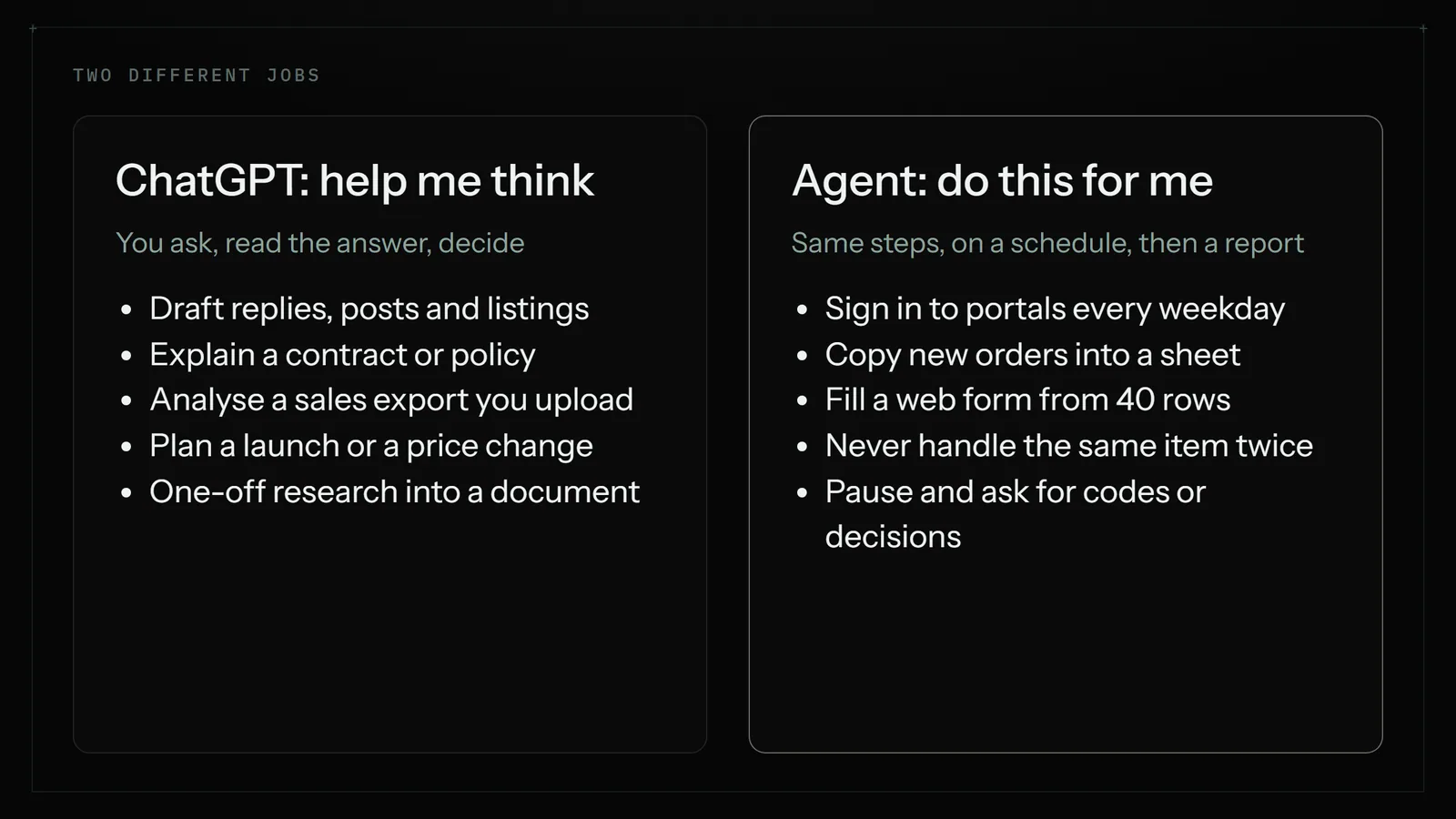
Four signs a job has outgrown a chat window:
- It is the same steps every time. Sign in to the wholesaler portal, open this week's orders, copy each one into the Orders sheet. You don't need ideas, you need it done the same way at 7:30 every weekday.
- It must not repeat itself. Emailing a lead twice, or adding the same invoice to a sheet twice, is worse than not doing it. A scheduled browser agent with task memory keeps track of what it has already handled. A chat prompt that runs on a timer starts each run fresh unless you build that tracking yourself.
- It touches sites without an integration. Supplier portals, government forms, marketplace back offices and old booking systems rarely have a ChatGPT connector or a Zapier integration. Something has to open the page and click.
- You have more than a handful of them. Plus allows 5 active scheduled tasks. An order check, a price check, an invoice sweep, a weekly report and a lead list use them all.
None of this makes ChatGPT a bad tool. It means the job has changed from "help me think" to "do this for me, on a schedule, and tell me what you did".
Which tool for which job
Here is how a typical week's jobs split, with the third common option, connector tools such as Zapier or Make, included because they are often the cheapest answer when both apps have an integration (see Zapier vs an AI browser agent).
| Job | Best fit | Why |
|---|---|---|
| Draft a reply to an unhappy customer | ChatGPT | You want words to edit, once |
| Summarise a supplier's new terms | ChatGPT | Reading and explaining is its strength |
| Which products sold best last quarter | ChatGPT | Upload the export, ask the question |
| Compare five suppliers' published prices, once | ChatGPT Work | One-off research that ends in a table |
| New Shopify order adds a row to a sheet | Zapier or Make | Both apps have integrations; pure rules |
| Every weekday, sign in to a supplier portal and log new orders | Browser agent | Same steps, behind a login, no integration |
| Every Friday, move invoices from Gmail and supplier portals into a sheet, skipping ones already there | Browser agent | Follows links into portals and remembers what it has done |
| Fill the same web form from 40 rows in a sheet | Browser agent | Repetitive form-filling on a website |
| Refunds, payments, turning ad spend on | You | Money moves stay with a person |
A worked example: a three-person online shop
Say you sell homeware on Etsy and your own site, buy stock from two wholesalers with web portals, and run a small Google Ads campaign. Here is a realistic split.
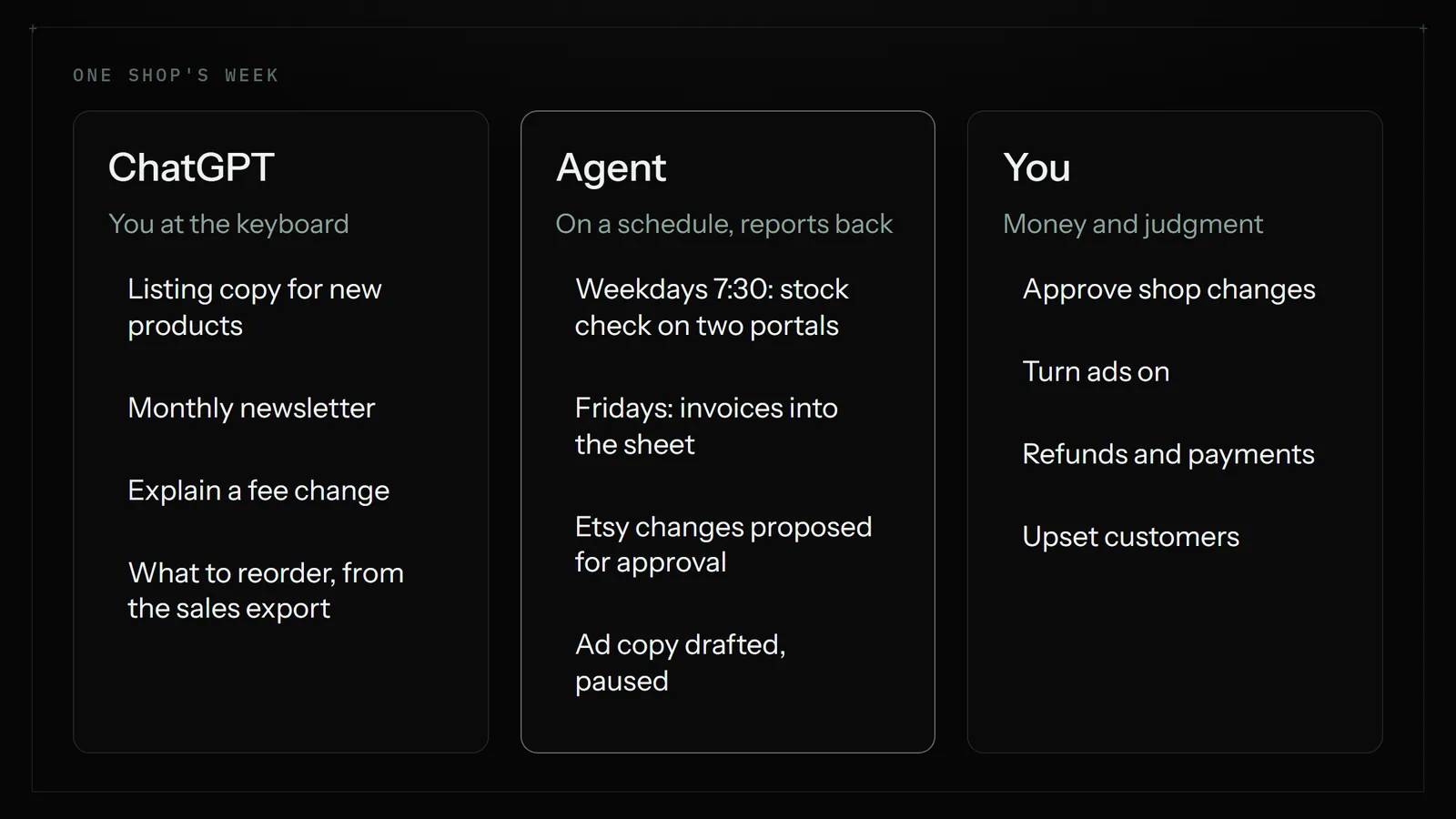
In ChatGPT (Plus, $20 a month): you draft listing copy for new products, write the monthly newsletter, ask it to explain a change in Etsy's fee policy, and upload last month's sales export to see what to reorder. You are at the keyboard for all of it, and it saves you a few hours a week.
In a browser agent: every weekday at 7:30 it signs in to both wholesaler portals, checks stock on your 15 best sellers and adds a row to your Stock sheet for anything low. Every Friday it moves the week's invoices into your Invoices sheet and emails you a summary. The Etsy Manager proposes price and description changes you approve before anything changes in the live shop. The Google Ads Manager reads how the ads did and drafts new ad copy, and everything it creates starts paused.
With you: approving the Etsy changes, turning ads on, any refund, and anything a customer is upset about.
The two tools don't overlap much. ChatGPT helps you think and write faster. The agent takes away the clicking you would otherwise do every morning. Astarii's Pro plan is $29.99 a month with 900 cloud minutes plus 800 browser minutes, which covers a daily 10-minute check and a weekly sweep with room to spare; see pricing for the larger plans.
Using ChatGPT and an agent together
You don't have to pick. Astarii can think with your own ChatGPT plan if you link it, so the plan you already pay for does the reasoning while Astarii does the clicking in a real browser. The connections guide covers linking it, along with Gmail or Outlook, Google Sheets, Docs, Calendar and Drive.
A few practical habits help:
- Write the instruction in ChatGPT first. If you aren't sure how to describe a job, ask ChatGPT to turn your rough notes into clear, numbered steps, then give those steps to the agent.
- Keep the judgment calls in chat. Let the agent gather the numbers every Friday, then paste the summary into ChatGPT and ask what stands out.
- Don't give either tool money decisions. Refunds, payments and switching on ad spend stay with you. Astarii pauses and asks when a site texts a code or something needs a decision, and its saved passwords are encrypted in your browser and never shown to the AI.
When an agent is the wrong pick
Be honest about the size of the job. If your repeated work is mostly writing and answering questions, ChatGPT alone is enough and cheaper. If every app in the job has an integration and the job is pure rules ("new form entry, add a row, send a welcome email"), a connector tool is faster and cheaper per run. If the job happens once, do it yourself or use ChatGPT Work. An agent earns its keep on the repeated, rule-based work on websites behind a login, the kind you do on autopilot every morning and would happily never do again.
Ten ChatGPT prompts that pay off for a small business
These work on any plan. Replace the brackets with your details.
- "Here is a customer complaint [paste]. Write a reply that apologises once, explains what we'll do, and stays under 120 words."
- "Rewrite this product description [paste] for someone searching for [keyword]. Keep every fact, cut it to 80 words, and give me three title options under 140 characters."
- "Read this supplier contract [paste]. List what I must do, by when, and anything that lets them change prices."
- "Here is last quarter's sales export [upload]. Which 10 products made the most profit, and which sold fewer than 5 units?"
- "I want to raise prices 8%. Draft a short note to regular customers that explains why without sounding defensive."
- "Turn these rough notes [paste] into a one-page process a new hire can follow, with numbered steps."
- "Write a job ad for a part-time packer, 15 hours a week, in plain English, with the pay and hours in the first two lines."
- "Give me 10 questions a first-time customer might ask before buying [product], with short answers for our FAQ page."
- "Summarise this email thread [paste] in five bullets and tell me what I still need to reply to."
- "I have $500 a month for marketing. Ask me five questions about my business, then suggest how to split it."
If a prompt like these starts running every week on a website rather than in a chat, that is the moment to hand it to an agent. Try three free Astarii runs of up to 15 minutes each, with no card, from astarii.ai, or follow your first Astari to set one up in a few minutes. Plans start at $29.99 a month on the pricing page.
Say it to an Astari
These are instructions you can give an Astari, word for word. It does the work in a browser, on a schedule if you want one, and asks you before anything goes live.
Questions
Is ChatGPT good for small business?
Yes, for writing, summarising documents, analysing a sales export and planning. You stay in the loop and edit what it gives you. It is less suited to repeating the same clicks on websites every day without you.
Which ChatGPT plan is best for a small business?
For one owner who uses it daily, Plus at $20 a month. Once two or more people use it for work, Business at $25 per user a month, or $20 billed yearly, with a two-seat minimum, adds a shared workspace and admin controls. Check chatgpt.com/pricing, as plans change often.
How much is ChatGPT Business per month?
In October 2026, OpenAI lists Business at $25 per user per month billed monthly, or $20 per user per month billed yearly, with a minimum of 2 seats. Prices can vary by country.
What is the ChatGPT small business program?
An OpenAI training push launched in July 2026: webinars on using ChatGPT Work for accounting, marketing and ecommerce, in-person academies in US cities, and partner skills and offers from companies including Shopify, Intuit and Wix. It is not a separate plan or price.
Can ChatGPT log into websites and do tasks for my business?
ChatGPT Work can use a cloud browser, which pauses at a sign-in page so you can sign in through a secure form. Some sites block automated browsers. It suits one-off tasks; for the same steps every weekday, a scheduled browser agent with task memory fits better.
How many scheduled tasks can ChatGPT run?
Per OpenAI, 3 active tasks on Free and Go, 5 on Plus, 10 on Business and 15 on Pro and Enterprise. Paid plans can repeat a task up to once an hour.
What is the difference between ChatGPT and an AI agent like Astarii?
ChatGPT is built around a conversation: you ask, it answers. Astarii does scheduled online work in a real browser: it signs in, fills in forms, updates spreadsheets, never does the same item twice, and reports back. Astarii can think with your own ChatGPT plan if you link it.
Is it safe to put customer data into ChatGPT?
Read the data controls for your plan first. OpenAI says Business keeps business data out of model training by default. Avoid pasting payment details or anything you would not want stored, and keep refunds and payments with a person.
- ChatGPT pricing
- OpenAI Help Center: Manage your ChatGPT Business subscription
- OpenAI: Introducing the ChatGPT small business program
- Shopifreaks: OpenAI launches a ChatGPT for small business program
- Inc.: OpenAI unveils a push to turn small-business owners into AI power users
- OpenAI Help Center: Scheduled tasks in ChatGPT
- OpenAI Help Center: Using cloud browser in ChatGPT
- OpenAI Help Center: GPT-5.6 in ChatGPT
filed under AI agents explained