Zapier vs an AI Browser Agent: Which Fits a 3-Person Business?
Everyone says "just Zapier it". Sometimes that's right, and sometimes the job lives on a website Zapier can't reach. Here is how to tell which, what each costs, and why most small teams end up using both.

Use Zapier, Make or n8n when every app in the job has an integration and the job is pure rules: they are fast and cheap, with Zapier Professional from $19.99 a month billed annually. Use a browser agent such as Astarii, from $29.99 a month, when the work sits on websites with no integration or needs some reading. Most 3-person businesses need both.
You run a business with two other people. Somebody spends Friday afternoon copying order totals out of a supplier portal, someone else pastes new leads from a web form into a spreadsheet, and everyone has heard that "you should just Zapier it." Sometimes that advice is right. Sometimes the job lives on a website that Zapier can't reach, and you spend an evening building a Zap that never quite works.
This guide compares the two main ways a small team automates online busywork in 2026: a connector tool like Zapier (or Make, or n8n), and an AI browser agent such as Astarii that opens websites, signs in and clicks through pages the way a person would. It covers what each costs, which jobs suit which, and why many small teams end up using both. If AI agents are new to you, start with the guide to AI agents for small business.
Two kinds of automation, in plain words
Connector automation moves data between apps through their official integrations. Zapier calls each automation a Zap: when something happens in one app (a new form entry, a new Gmail message, a paid Stripe invoice), do something in another app (add a row, send a Slack message, create a contact). It never opens a web page. It talks to each app's API, which is a back door the app maker built for exactly this. Zapier's directory lists more than 9,000 apps, so if your tools are popular, there is probably a ready-made connection.
A browser agent works in a real browser instead. You describe the job in plain English ("sign in to the supplier portal every Friday, download this week's invoices, add the totals to my sheet and email me a summary"), and the agent reads the page, clicks, types, uploads files and signs in with saved logins. It doesn't need the website to offer an integration. If a person can do it in a browser, the agent can usually do it too, more slowly than an API but without anyone building anything.
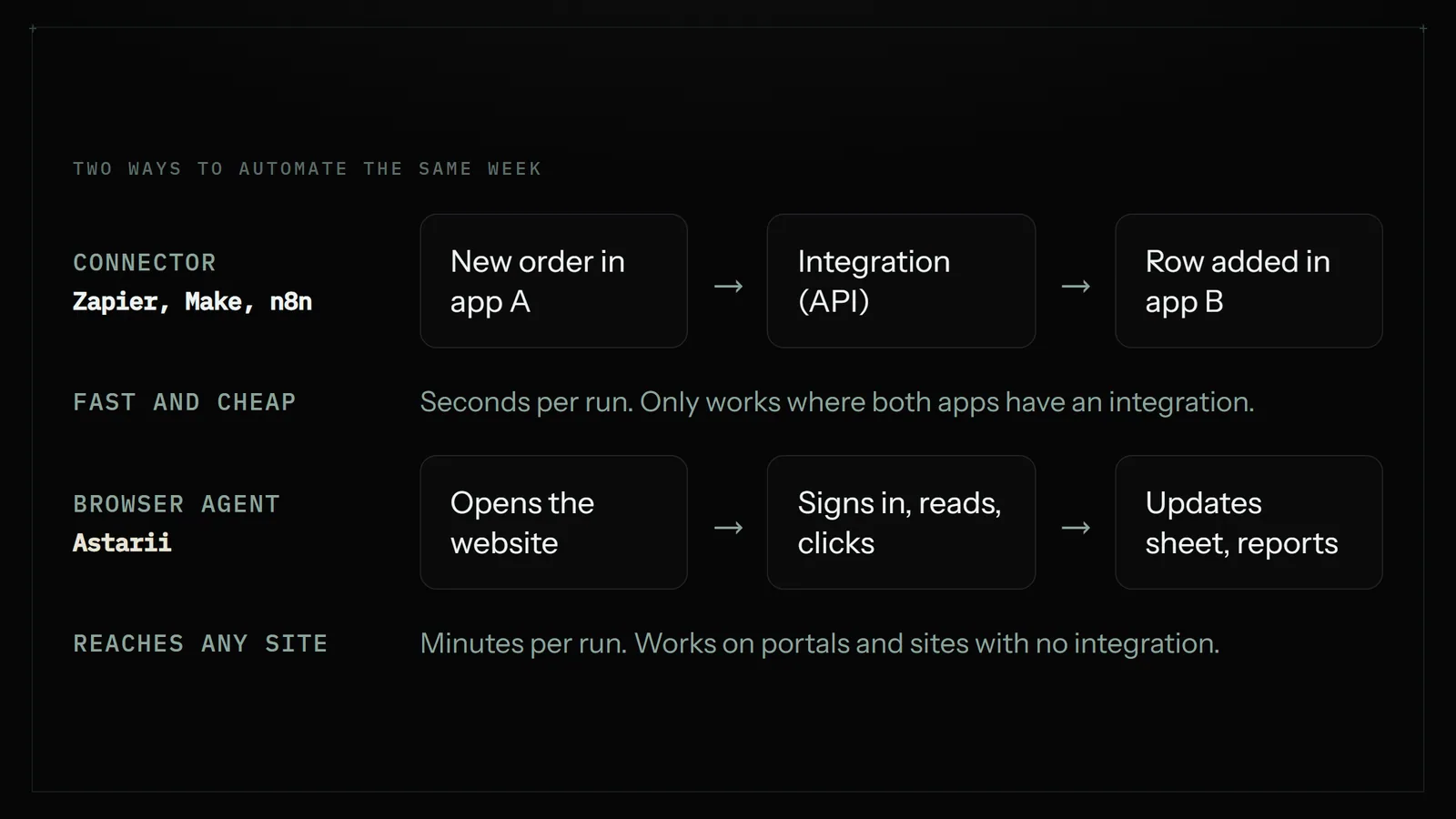
Neither one is "smarter". They solve different problems. The connector is a fast, cheap pipe between apps that already talk to each other. The browser agent is a patient worker for the sites that don't.
What Zapier does well (and it does a lot)
It's worth being fair here, because for many small-business jobs Zapier is the better pick.
- Speed. A Zap that fires on an instant trigger runs in seconds. A form entry can be in your CRM before the customer has closed the tab. A browser agent takes minutes to open pages and click through them.
- Cost per action at volume. Zapier's Professional plan starts at $19.99 a month billed annually, or about $29.99 month to month, for 750 tasks, where a task is one successful action step. If you move hundreds of rows a day between two well-known apps, a pipe is the cheaper way to do it.
- Reliability on supported apps. APIs are stable contracts. A Zap doesn't care if the app redesigns its website next week.
- Breadth. With more than 9,000 apps listed, the odds are good that your form tool, CRM, calendar and accounting app all have a Zapier connection.
- It has AI too. Zapier now sells Zapier Agents, priced separately by "activities", which can search and browse the web and act in connected apps. Reviewers in 2026 list a free tier of about 400 activities a month and a Pro tier around $50 a month for 1,500. Check Zapier's own page before you buy.
If your job is "when X happens in app A, put it in app B" and both apps are on Zapier's list, use Zapier. It will be faster and cheaper than any browser agent.
Where connector tools stop
The trouble starts with the sites a small business actually lives in that have no integration at all, or only a thin one.
- Supplier and wholesale portals where invoices or stock levels sit behind a login and a "Download" button.
- Government, licensing and tax sites with forms you fill in the same way every month.
- Marketplaces and job boards whose integrations cover only part of what you see on screen.
- Competitor websites whose prices you want to check, which will never offer you an API.
- Industry tools built by a small vendor who never got round to an integration.
For these, a connector tool has no door to knock on. You end up either doing the job by hand, paying a developer to write a scraper that breaks on the next redesign, or bolting on a separate scraping service. This is where a browser agent earns its keep: it uses the same front door you do.
The second limit is judgment inside a task. A Zap follows fixed rules: if the field says "paid", do this. Real admin work often needs a little reading. "Reply to anyone asking about pricing" means spotting which emails are pricing questions, even when nobody uses the word. Zapier has AI steps for this, and they help, but the rest of the Zap still has to be wired by hand. A browser agent takes the whole job as one plain-English instruction.
Zapier vs a browser agent: side by side
| Zapier (connector) | Astarii (browser agent) | |
|---|---|---|
| How you set it up | Pick a trigger app, an action app, map the fields | Describe the job in plain English, or show it once |
| What it can reach | Apps with a Zapier integration (9,000+) | Any website you can use in a browser, plus Gmail or Outlook, Sheets, Docs, Calendar and Drive |
| Speed per run | Seconds | Minutes (it opens and reads pages) |
| Sites behind a login with no integration | No | Yes, with saved logins that are encrypted and never shown to the AI |
| Sign-in codes (2FA) | Handled by each app's connection | The run pauses and asks you, then carries on |
| Schedules | Yes | Yes: every weekday at 7:30, three times a day, every Friday |
| Runs with your laptop closed | Yes | Yes, in the cloud |
| Starting price | Free (100 tasks); Professional from $19.99/mo annually | 3 free runs, no card; Pro $29.99/mo for 900 cloud minutes |
| How it's metered | Tasks (each action step) | Minutes of run time |
| Best for | High-volume app-to-app data moves | Repeated work on websites with no integration |
Prices are from Zapier's pricing page and Astarii's pricing page on 20 October 2026. Make and n8n sit in the same column as Zapier: they are connector tools too, usually cheaper per action and a bit more technical. Make's Core plan is reported at about $9 a month billed annually for 10,000 credits, and n8n Cloud's Starter at about €20 a month billed annually for 2,500 workflow runs, with a free self-hosted edition if you are happy running a server.
A worked example: a 3-person business, five jobs
Take a small home-goods shop: an owner, a part-time assistant and a bookkeeper who comes in on Fridays. Here are the five repeat jobs eating their week, and which tool fits each.
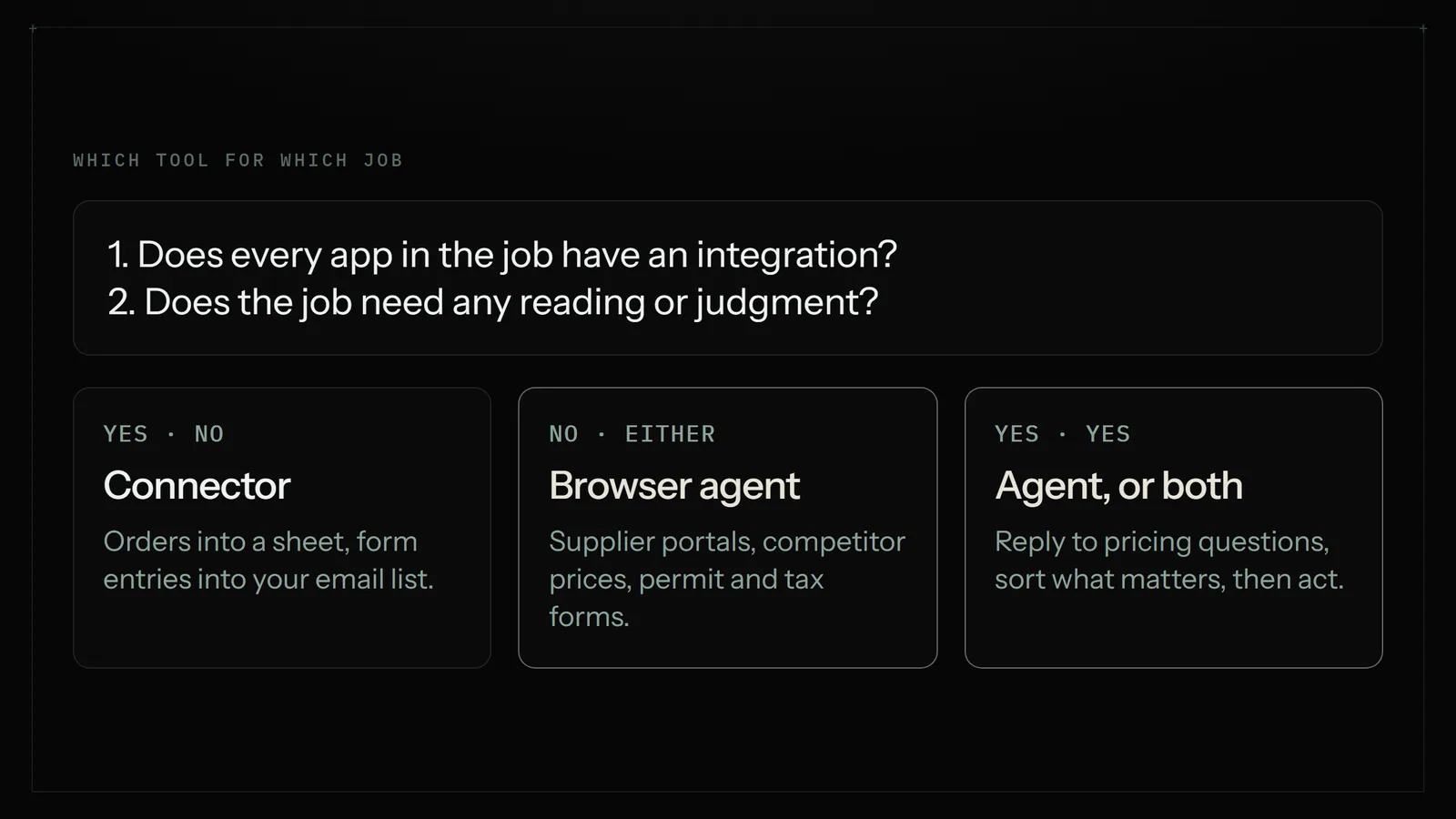
- New website orders into the order sheet. The shop platform has a Zapier integration and an instant trigger. Zapier. It's a pipe between two apps, it runs in seconds, and it might use 300 tasks a month.
- New contact-form entries into the email list. Same shape: form tool to email tool, both on Zapier's list. Zapier.
- Friday supplier invoices. Two suppliers email a "View invoice" link that opens a portal behind a login. There is no integration. Someone currently signs in, downloads each PDF and types the totals into a sheet. Browser agent. It signs in, follows the links, adds only new rows and emails the bookkeeper a summary. Our Gmail-invoices-to-Sheets guide walks through this job.
- Competitor prices on five sites, every weekday. None of those sites will ever have an integration for you. Browser agent on a 7:30 weekday schedule, writing to a sheet and flagging any change over 5%.
- Customer emails asking about wholesale pricing. Needs reading, not rules. Browser agent connected to Gmail: "reply to anyone asking about wholesale pricing with our price sheet, and copy me."
So the honest answer for this shop is both: Zapier's free or entry plan for jobs 1 and 2, and a browser agent for 3 to 5. Trying to force jobs 3 and 4 into Zapier means paying for a scraper or a developer. Trying to run jobs 1 and 2 through a browser agent means paying for minutes to do something a pipe does in a second.
What each costs for a small team
The two tools are metered differently, so compare them on a real week of work rather than on headline prices.
Zapier counts tasks. Each successful action step is one task; triggers and filters don't count. A Zap that adds a row and sends a Slack message uses two tasks per run. The free plan gives 100 tasks a month on two-step Zaps. Professional starts at 750 tasks for $19.99 a month billed annually and climbs with volume, and the Team plan starts around $69 a month billed annually for shared workspaces.
Astarii counts minutes. A run's real length is rounded up to the minute. Pro is $29.99 a month for 900 cloud minutes plus 800 browser minutes (runs in your own Chrome or on your PC), Max is $49.99 for 1,600 cloud plus 2,000 browser minutes, and Ultra is $99.99 for 3,400 plus 4,500. Pools reset on the 1st, and a top-up of 250 extra cloud minutes costs $9.99. You can try it with 3 free runs of up to 15 minutes each, no card.
For the shop above, a rough month looks like this: Zapier's entry plan covers the order and form pipes. The three browser-agent jobs (a 10-minute Friday invoice run, a 6-minute weekday price check, and a few short inbox runs) land well inside Astarii Pro's 900 cloud minutes. Your own run lengths will differ, so measure a week before choosing a tier.
When a browser agent is the wrong pick
- Instant reactions. If a lead must hit your CRM within seconds, use a connector with an instant trigger.
- Heavy volume between two supported apps. Thousands of rows a day is pipe work. Paying minutes for it is waste.
- Jobs that are already one click. If the app has a built-in "export to Sheets" or a native automation, use that first.
- Anything that moves money unsupervised. Keep refunds, payments and turning on ad spend for yourself. Astarii's own ready-made helpers are built that way: the Etsy Manager proposes every change to your live shop before making it, and the Google Ads Manager creates everything paused.
And when a connector tool is the wrong pick: any job on a website with no integration, any job that changes shape each week, and any job you would describe more easily in a sentence than in a flowchart.
Logins, codes and approvals
A fair worry with a browser agent is handing it your logins. Here is how Astarii handles it, so you can compare it to whatever else you are considering. Saved passwords are encrypted in your browser before they are stored and are never shown to the AI. When a site texts a sign-in code, the run pauses and asks you, then carries on from where it stopped. Changes to a live shop are proposed first, and ad campaigns start paused. The identities and sign-ins doc covers the details.
Zapier's model is different: each app connection uses that app's own sign-in, usually OAuth, so Zapier holds a token rather than your password. That is one of the real advantages of an integration when it exists.
How to try both in an afternoon
- List your repeat jobs. Write down every online task someone does more than twice a week, with the sites involved.
- Mark each one. If every app in the job is on Zapier's directory and the job is pure rules, mark it "connector". If any site has no integration, or the job needs reading, mark it "agent".
- Build the easiest connector job on Zapier's free plan.
- Hand the easiest agent job to an Astari using the free runs. Describe it in plain English, or show it once (see your first Astari), then put it on a schedule.
- Measure for a week: tasks used, minutes used, and the hours you got back. Then pick your plans.
If you are weighing a person against software for the same list, the virtual assistant vs AI agent comparison covers that split, and the website-to-Sheets data entry guide shows the agent side of a job step by step.
Say it to an Astari
These are instructions you can give an Astari, word for word. It does the work in a browser, on a schedule if you want one, and asks you before anything goes live.
Questions
What is the difference between Zapier and an AI agent?
Zapier connects apps through their official integrations and follows fixed rules: when something happens in one app, do something in another. A browser agent works in a real browser, reading pages, clicking, typing and signing in, so it can do jobs on websites that have no integration.
What is the best Zapier alternative for a small business?
For the same kind of app-to-app automation, Make and n8n are the usual picks: Make is reported at about $9 a month billed annually for 10,000 credits, and n8n can be self-hosted free. For work on websites with no integration, a browser agent like Astarii is a different tool rather than a cheaper Zapier.
How much does Zapier cost in 2026?
Zapier's free plan includes 100 tasks a month. Professional starts at $19.99 a month billed annually, or about $29.99 month to month, for 750 tasks, and rises with volume. Team starts at $69 a month billed annually. Each successful action step is one task.
Can Zapier log into a website and click buttons for me?
Zaps work through app integrations, not by clicking through websites. Zapier Agents, sold separately, can browse and search the web. For repeated jobs on sites behind a login with no integration, such as supplier portals, a browser agent that signs in with saved logins is the more direct fit.
Is a browser agent slower than Zapier?
Yes. A Zap with an instant trigger runs in seconds. A browser agent opens and reads pages, so a run takes minutes. That is fine for a Friday invoice job or a morning price check, and the wrong choice when a lead must reach your CRM instantly.
Can I use Zapier and Astarii together?
Yes, and many small teams should. Keep high-volume app-to-app pipes on Zapier, and give an Astari the jobs on websites with no integration or the jobs that need reading, such as replying to pricing questions from Gmail.
Is it safe to give a browser agent my passwords?
With Astarii, saved passwords are encrypted in your browser before they are stored and are never shown to the AI. When a site texts a sign-in code, the run pauses and asks you. Changes to a live shop are proposed first and ad campaigns start paused.
Do I need to code to use either one?
No. Zapier uses a point-and-click builder where you pick apps and map fields. Astarii takes a plain-English instruction, or you show it the job once, then you choose a schedule. n8n is the most technical of the connector tools, especially self-hosted.
filed under Tools compared