Etsy Pricing Calculator: How to Price a Listing After Fees (Worked Examples)
Most calculators tell you what a price leaves you. This one runs the other way: start from the profit you want and get the price you need, with the fees read from Etsy this week.

To price an Etsy listing after fees in the US, add your costs, the profit you want and $0.45, then divide by 0.905. Etsy keeps 6.5% plus 3% of the sale, a $0.25 processing fee and a $0.20 listing fee. A mug costing $18.50 with an $8 target needs $29.78. Orders from Offsite Ads cost 12% or 15% more.
Most Etsy calculators answer the wrong question. You type in a price and they tell you what's left. What a seller usually needs is the reverse: "I want to keep $8 on this mug. What do I have to charge?"
This guide is that calculator, written out. It has the fee rates read from Etsy's own help pages on November 17, 2026, one formula that turns your costs and your target profit into a price, five worked examples, and the same maths as Google Sheets formulas you can paste in. Near the end it covers what to do once you have the numbers and 60 listings to change, which is where a helper such as the Astarii Etsy Manager can save an evening. If AI helpers are new to you, the guide to AI agents for small business covers the basics.
What Etsy takes from a US sale
Four fees matter for pricing. Three of them apply to every order, and the fourth only applies to some.
| Fee | Rate | Charged on | When |
|---|---|---|---|
| Listing fee | $0.20 | Each listing, and each renewal | When you list, every 4 months, and again each time the item sells and renews |
| Transaction fee | 6.5% | Item price plus the shipping and gift wrap you charge | Every sale |
| Payment processing | 3% + $0.25 | The total the buyer pays, including shipping and any sales tax | Every Etsy Payments sale |
| Offsite Ads | 15%, or 12% for shops that have passed $10,000 in a 365-day period | The order total, capped at $100 per order | Only when the buyer clicked one of Etsy's ads on another site in the 30 days before buying |
Put the first three together and the rule of thumb for a US shop is short: Etsy keeps 9.5% of what the buyer pays you, plus 45 cents. The 9.5% is the 6.5% transaction fee plus the 3% processing fee. The 45 cents is the $0.25 processing flat fee plus the $0.20 it costs to relist the item you just sold.
Two more costs sit outside the per-order maths. Etsy Ads, the ads inside Etsy's own search, run on a daily budget you set. And a listing that never sells still costs $0.20 every four months. Both belong in your pricing as a monthly cost spread over your sales, which the section on forgotten costs covers.
The Etsy pricing formula
Start with two numbers you choose and work backwards to the price.
- Your costs per item: materials, packaging, the postage you pay, and your own time at an hourly rate.
- Your target profit per item: what you want left over after all of that, in dollars.
Then the price is:
Price = (costs + target profit + $0.45) ÷ 0.905
"Price" here means everything the buyer pays you before sales tax: the item plus any shipping you charge. The 0.905 is what remains of each dollar after the 9.5%. If you offer free shipping, the whole amount is the listing price. If you charge $5 shipping, take $5 off the answer to get the listing price. Etsy's percentage fees apply to shipping as well, so the split makes no difference to what you keep.
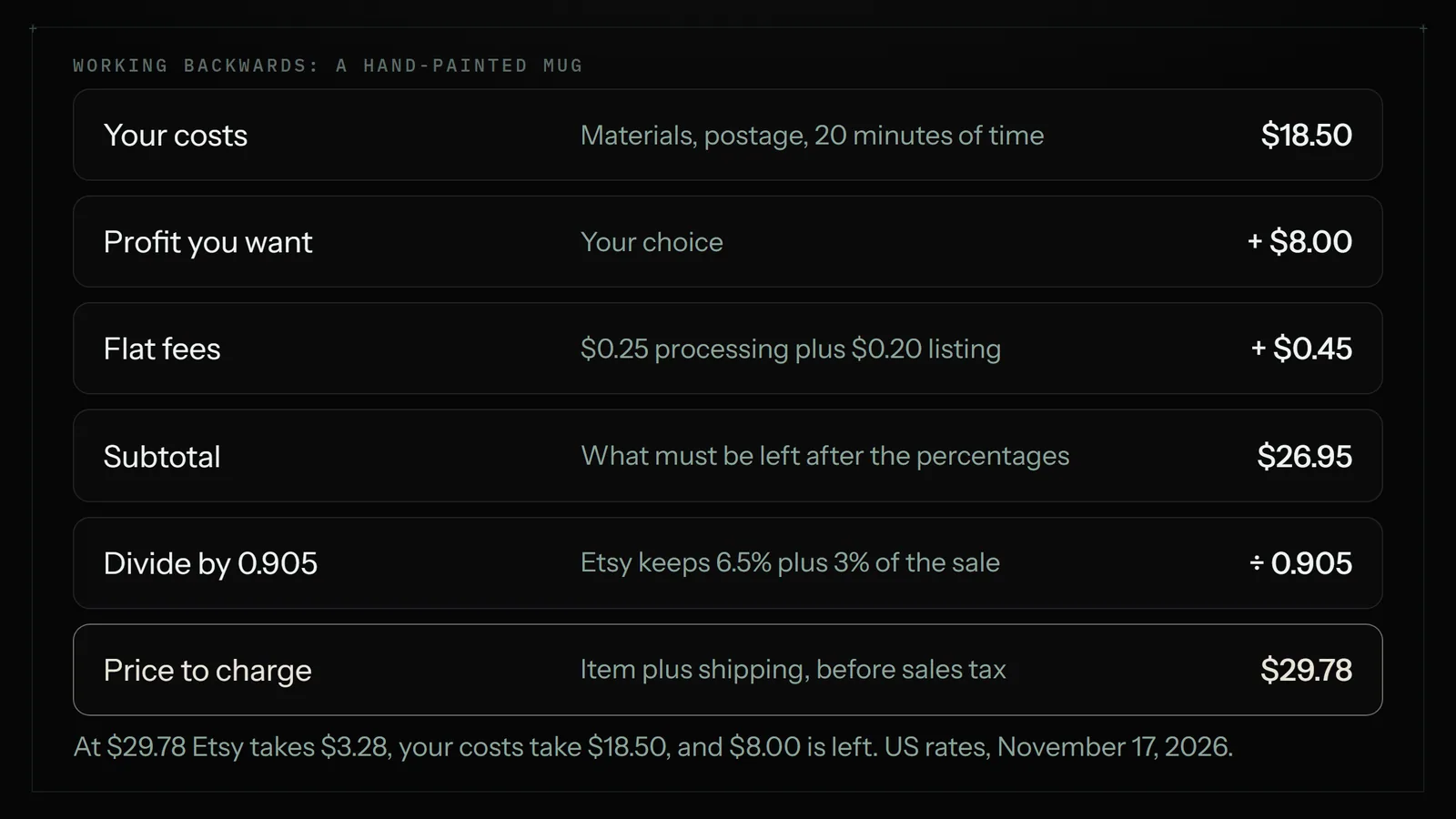
Take a hand-painted mug. Materials are $8.00, the box and postage come to $4.50, and it takes 20 minutes to paint and pack, which at $18 an hour is $6.00. Costs: $18.50. You want $8.00 of profit on top.
Price = ($18.50 + $8.00 + $0.45) ÷ 0.905 = $29.78
Check it forwards. At $29.78, the transaction fee is $1.94, processing is $1.14 and the listing renewal is $0.20. That's $3.28 to Etsy. Take off your $18.50 of costs and $8.00 is left, as planned. You'd list it at $29.99 or $30 and keep a few cents more.
If you think in margins instead of dollars
Some sellers set a percentage: "I want 30% of the price to be profit." The formula changes slightly, because the profit now grows with the price:
Price = (costs + $0.45) ÷ (0.905 − margin)
For the mug at a 30% margin: ($18.50 + $0.45) ÷ (0.905 − 0.30) = $31.32. Use whichever version matches how you think. The dollar version is easier to sanity-check on cheap items, where a healthy-looking percentage can still be 90 cents.
Five worked examples
The same formula, applied to five kinds of listing. Costs include your time. The last column shows what you'd need to charge if you wanted to keep the same profit even on an order that came through Offsite Ads at 15%; more on that choice below.
| Item | Your costs | Target profit | Price needed | Etsy's share at that price | Price if every sale paid 15% Offsite Ads |
|---|---|---|---|---|---|
| Sticker sheet | $1.50 | $1.50 | $3.81 | $0.81 (21.3%) | $4.57 |
| Printable (digital download) | $0.00 | $4.00 | $4.92 | $0.92 (18.7%) | $5.89 |
| Hand-painted mug | $18.50 | $8.00 | $29.78 | $3.28 (11.0%) | $35.70 |
| Custom necklace | $22.00 | $18.00 | $44.70 | $4.70 (10.5%) | $53.58 |
| Small side table | $185.00 | $90.00 | $304.36 | $29.36 (9.6%) | $364.83 |
These are illustrations, not benchmarks. Your costs will differ, and the target profit is yours to set. What carries over is the shape: Etsy's share falls from over 21% on a $4 item to under 10% on a $300 one.
Why cheap items are the hardest to price
The 45 cents doesn't shrink when your price does. On a $5 sale, Etsy's three standard fees add up to $0.93, which is 18.6% of the sale. On a $50 sale they come to $5.20, or 10.4%. On $100 it's $9.95, just under 10%.
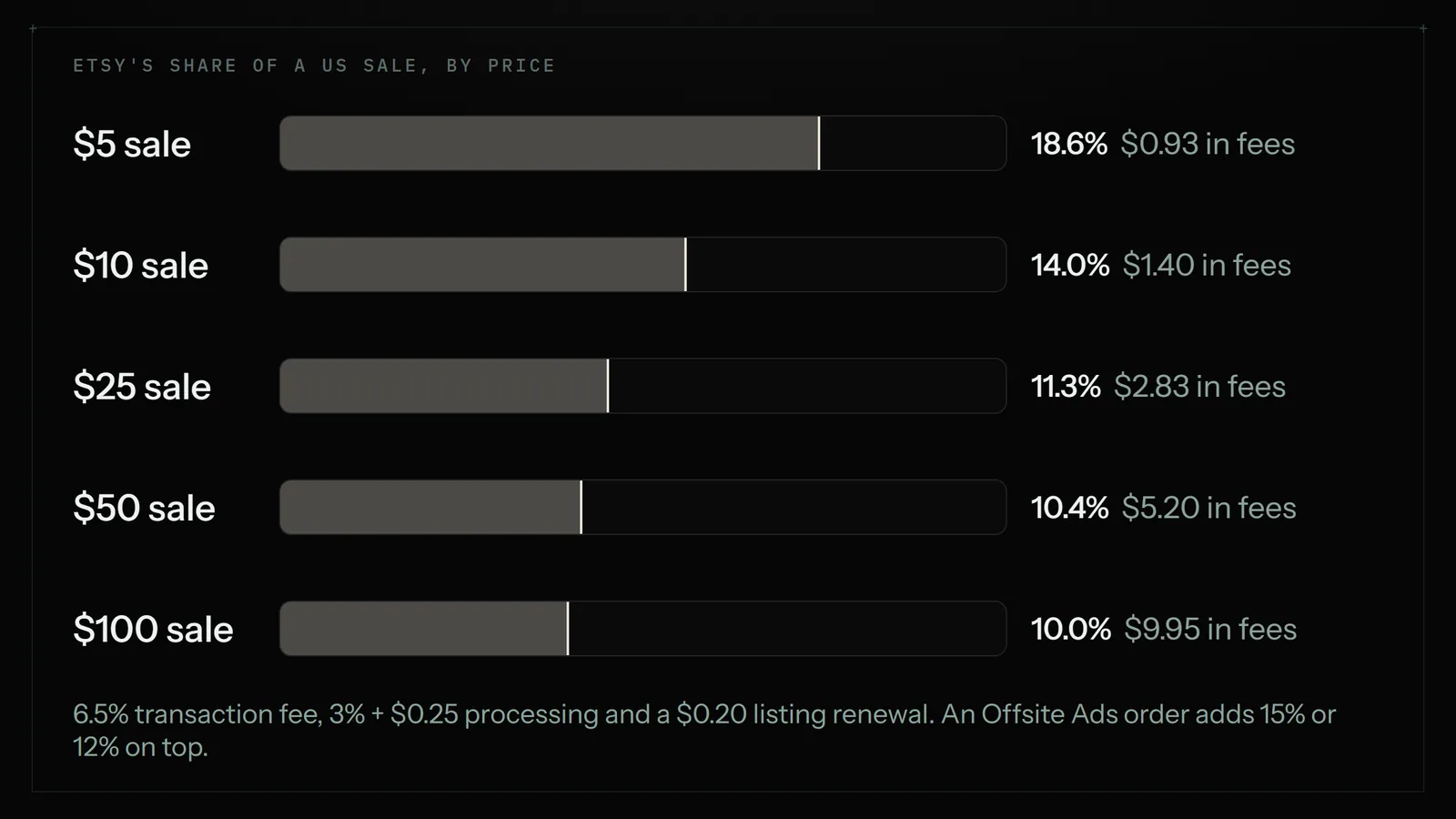
That's why sticker and printable sellers feel squeezed while furniture makers barely notice the flat fees. Three fixes work at the low end:
- Bundle. Three sticker sheets in one $10 listing pay the $0.25 processing flat fee once, not three times. Note that each extra quantity sold from a listing still costs $0.20.
- Raise the floor. Work out the lowest price where a listing still earns something worth your time, and don't list below it. For many shops that floor is $4 to $6.
- Sell the set, list the single. Keep a single item for people who want one, priced honestly, and make the bundle the obvious choice.
Offsite Ads: price for them or not?
Offsite Ads are Etsy's ads on Google, Facebook, Instagram, Pinterest, Bing and partner sites. You don't choose which listings are advertised. You pay only when a buyer clicks one of those ads and orders from your shop within 30 days. Etsy's help page gives two rates:
- 15% if your shop has never made $10,000 or more in any 365-day period. You're enrolled automatically, and you can opt out in Shop Manager under Settings, then Offsite Ads.
- 12% once your shop has made $10,000 or more in a 365-day period. From then on you're required to take part for the life of the shop.
The fee never exceeds $100 on a single order. On the mug at $29.78, an Offsite Ads order costs you another $4.47, so your $8.00 becomes $3.53. You have three honest ways to handle that.
- Price every listing as if the ad fee always applies. Divide by 0.755 instead of 0.905 (or 0.785 at the 12% rate). The mug becomes $35.70. Safe, but you may price yourself out of searches where rivals didn't do this.
- Blend it. Look at your Offsite Ads dashboard under Marketing and see what share of your orders the ads brought in. If it's one order in ten, subtract a tenth of 15% from the divisor: 0.905 − 0.015 = 0.89. The mug becomes $30.28, and across a hundred sales the ad fees are covered.
- Opt out, if you're under the $10,000 mark and the ad orders aren't worth it at your margins. You give up those sales entirely, so check the dashboard before you decide.
For most small shops the blend is the sensible one. It treats the ad fee as what it is: a marketing cost spread across all your sales, not a penalty on one unlucky order.
Sales, coupons, free shipping and sales tax
Sales and coupons. If you run a 20% off sale, the buyer pays 80% of the listed price and your formula price has to survive that. Divide by 0.80: the mug needs a listed price of $37.23 for the sale price to land on $29.78. If you run sales often, price for the sale and treat the full price as a bonus.
Free shipping. Moving shipping into the item price changes nothing in the fees, because Etsy charges its percentages on shipping too. Just make sure the postage you pay is in your costs, at the rate for your furthest usual buyer, not your nearest.
Sales tax. When Etsy collects sales tax from the buyer, it isn't your income, and the 6.5% transaction fee doesn't apply to it. The 3% processing fee does: Etsy's fee page says processing is taken from the total including sales tax. At an 8% tax rate that moves the mug from $29.78 to $29.86. It's a few cents per order; build in a small cushion and move on.
If you sell from outside the US
The formula keeps its shape; the numbers change. Three things to swap in from Etsy's pages for your country:
- Processing rate. Etsy lists it by the location of your bank account. On November 17, 2026 the page showed 4% + £0.20 for the United Kingdom, 3% + C$0.25 for Canadian domestic and US orders, 3% + A$0.25 for Australian domestic orders, and 4% + €0.30 for most euro countries.
- Regulatory operating fee. Sellers in the UK, France, Italy, India, Spain, Türkiye, Vietnam and Canada pay an extra percentage on the order total. The rate differs by country, so read it from Etsy's fee page and add it to the 9.5%.
- Currency conversion and VAT. If you list in a currency other than your bank account's, Etsy charges 2.5% to convert your funds. In some countries VAT is added to seller fees as well.
Rebuild the divisor for your own case. A UK seller, for example, starts from 1 − 0.065 − 0.04 − their regulatory rate, and the flat part becomes £0.20 plus the listing fee converted from $0.20.
The calculator as a Google Sheet
A sheet beats a web calculator once you have more than a handful of listings, because it prices all of them at once and keeps your costs in one place. Make a tab called Pricing with one row per listing and these columns.
- A Listing name
- B Materials and packaging
- C Postage you pay
- D Minutes of your time
- E Target profit in dollars
- F Costs:
=B2+C2+D2/60*18(swap 18 for your hourly rate) - G Floor price, the least you can charge and still hit your target:
=ROUND((F2+E2+0.45)/0.905,2) - H Price with your Offsite Ads share blended in:
=ROUND((F2+E2+0.45)/(0.905-0.15*0.1),2)(swap 0.1 for your own share of ad orders) - I Current price on Etsy
- J Profit at the current price:
=ROUND(I2*0.905-0.45-F2,2)
Column J is the one that changes minds. Fill it in for your ten best sellers and sort by it. Most shops find one or two listings that have been earning under a dollar for a year. If you already keep an Etsy order spreadsheet, the Costs tab from that guide feeds columns B and C here.
Costs sellers forget to put in
- Your time. If the price only works when your labour is free, the product is a hobby. Pick an hourly rate, even a modest one, and include making, photographing, messaging and packing.
- Packaging. Boxes, mailers, tissue, tape, labels and the thank-you card. Often $0.50 to $2.00 an order.
- Etsy Ads. Take last month's Etsy Ads spend, divide it by last month's orders and add the result to every item's costs. A $60 budget over 80 orders is $0.75 each.
- Listings that sit. Forty listings that each renew three times a year cost $24 whether or not they sell. Spread it across your orders, or retire the ones that haven't sold in a year.
- Remakes and refunds. If one order in thirty arrives broken, add about 3% to your costs.
- Tools and subscriptions. Design apps, research tools and equipment wear belong in the monthly overhead you divide across orders.
The formula gives you a floor, not the right price. If similar mugs sell at $38, charging $29.99 leaves money behind; if they sell at $22, you need a cheaper way to make it or a reason to be worth more. A weekly look at what rivals charge helps, and competitor price monitoring for small shops shows how to keep that in a sheet.
Calculator, sheet or helper: which to use
The maths is free. You never need to pay for it. What differs between the options is how much of the surrounding work they take off you.
| Option | Cost | Good for | Where it stops |
|---|---|---|---|
| The formula above and a phone calculator | Free | Pricing one new listing | You redo it for every listing |
| A free web fee calculator | Free | A quick check of what a given price leaves you | Most work forwards from a price, one item at a time, and you have to trust that their rates are current |
| Your own Google Sheet | Free | Pricing the whole shop and seeing profit per listing | You still type the new prices into Etsy by hand |
| Etsy's bulk price editing in Shop Manager | Free | The same change on many listings, such as all prices up 8% | It can't give each listing its own new price from a sheet |
| Astarii Etsy Manager | From $29.99 a month after 3 free runs | Comparing your live prices with the sheet and proposing a change per listing | It doesn't decide your costs or your target profit, and it changes nothing until you approve |
Be honest about scale. With 15 listings, the sheet and twenty minutes in Shop Manager is the right answer, and a paid helper is overkill. The helper earns its place when the shop has 60 or 200 listings, when prices need a recheck every time postage or materials move, or when the pricing job keeps getting put off because it means opening every listing.
Here's how that works with Astarii, per its published product facts. The Etsy Manager reads your orders and listings, answers questions about them and can update prices and descriptions. Every change to the live shop is proposed first and made only when you approve it. It also connects to Google Sheets, so the Pricing tab above can be the source of truth: the sheet does the maths, the Astari compares it with what's live and brings you a list. The guide to updating Etsy prices without opening every listing walks through that approval loop, and Etsy tools for sellers, sorted by job covers the rest of the stack.
What it won't do: it has no built-in fee table to lean on, so keep the rates in your own sheet and check them against Etsy's fee page a couple of times a year. And it won't pick your price for you. Whether a mug is worth $30 or $38 is a judgment about your buyers, and that stays with you.
Six pricing mistakes that eat the profit
- Working forwards only. Picking a price that feels right and then seeing what's left. Start from the profit you want.
- Leaving out the 45 cents. On a $40 item it's noise. On a $4 item it's most of the profit.
- Forgetting fees on shipping. The 6.5% and the 3% both apply to shipping you charge. If you charge the buyer exactly what the label costs, you lose 9.5% of it on every order.
- Ignoring Offsite Ads until the first big one. A 15% fee on a $300 order is $45. Decide how you're handling it before it happens.
- Pricing for the sale you never stop running. If the shop is always 20% off, the sale price is your real price. Do the maths on that.
- Setting prices once. Postage, materials and Etsy's own rates all move. Put a recheck on the calendar twice a year.
How to start this week
Build the Pricing tab and fill it in for your ten best sellers. Read column J. Raise anything that earns less than your target, and decide whether to bundle or retire anything under your floor. That's an hour, and for most shops it pays back in the first week.
If the shop is big enough that typing the new prices in is the part you dread, hand that part over. Sign up at astarii.ai; the free trial is 3 runs of up to 15 minutes each, with no card. Use the first run to ask which listings are priced under the floor in your sheet, and look at what it proposes before approving anything. The first-Astari guide covers setup, connections covers linking Google Sheets, and pricing lists the plans.
Say it to an Astari
These are instructions you can give an Astari, word for word. It does the work in a browser, on a schedule if you want one, and asks you before anything goes live.
Questions
How do I calculate what to charge on Etsy?
For a US shop, add your costs per item, the profit you want and $0.45, then divide by 0.905. The answer is what the buyer needs to pay you for the item plus shipping, before sales tax. A mug with $18.50 of costs and an $8 target profit needs $29.78.
How much does Etsy take from a $10 sale?
On US rates, $1.40: a $0.65 transaction fee (6.5%), $0.55 in payment processing (3% plus $0.25) and a $0.20 listing renewal. That is 14% of the sale. If the order came through Offsite Ads, add another $1.50 at the 15% rate or $1.20 at 12%.
What percentage does Etsy take per sale?
For a US seller, 9.5% of what the buyer pays you plus 45 cents: 6.5% transaction fee, 3% plus $0.25 payment processing, and a $0.20 listing fee. On a $50 sale that is about 10.4%; on a $5 sale it is 18.6%, because the flat 45 cents weighs more.
Does Etsy charge fees on shipping?
Yes. Etsy's help pages say the 6.5% transaction fee applies to the item price plus shipping and gift wrap, and payment processing is taken from the total including shipping. If you charge buyers exactly what the label costs you, you lose about 9.5% of that amount on each order.
Should I include Offsite Ads fees in my Etsy prices?
Usually as a blend. Check your Offsite Ads dashboard for the share of orders the ads bring in, then spread the 15% or 12% fee across all sales. If one order in ten is an ad order at 15%, divide by 0.89 instead of 0.905. Shops under $10,000 a year can opt out instead.
What is a good profit margin on Etsy?
There is no official figure. A workable test is whether the price covers materials, packaging, postage, Etsy's fees and your own time at an hourly rate, with profit left over. If the price only works when your time is free, raise it, bundle the item or make it faster.
Is there a free Etsy pricing calculator in Google Sheets?
You can build one in a few minutes. Put costs in F2 and target profit in E2, then use =ROUND((F2+E2+0.45)/0.905,2) for the price you need. To see profit at your current price in I2, use =ROUND(I2*0.905-0.45-F2,2). Both use US rates.
Can an AI agent change my Etsy prices for me?
It can propose them. The Astarii Etsy Manager reads your listings, can compare live prices with a Google Sheet, and proposes each price change; nothing in the live shop changes until you approve it. Plans start at $29.99 a month after 3 free runs. For a small shop, Etsy's free bulk editor is enough.
filed under Online selling