AI Employees Explained: What They Actually Do for a Small Business vs a Hire
Vendors sell everything from a named chatbot to software that signs into your accounts as an "AI employee". None of them is a person. Here is what the products actually do, what they cost next to a hire, and which jobs to give them.

An AI employee is software that does a defined online job for you, usually on a schedule: drafting replies, copying data into a sheet, checking orders or prices. It is not a person and cannot handle calls, judgment or money on its own. Plans cost about $30 to $100 a month, against roughly $1,700 a month for a 20-hour part-timer.
"AI employee" is a marketing phrase, not a job title. Vendors use it for anything from a chat window with a name and a cartoon face to software that signs into your accounts and does a morning's work while you sleep. None of them is a person, and none of them can be hired in the way you hire a person: no judgment you can trust unsupervised, no phone calls, no accountability when something goes wrong.
That doesn't make the idea useless. For a small business, the useful part of "AI employee" is a narrow one: software that takes a repeated online job off your list, does it on a schedule, and reports back. This guide explains what the products sold under the name really do, what they cost next to a hire, which jobs they do well, and which jobs still need a human. If you want to see the kind we make, here is how a first Astari is set up. For the wider picture, start with the guide to AI agents for small business.
What "AI employee" actually means
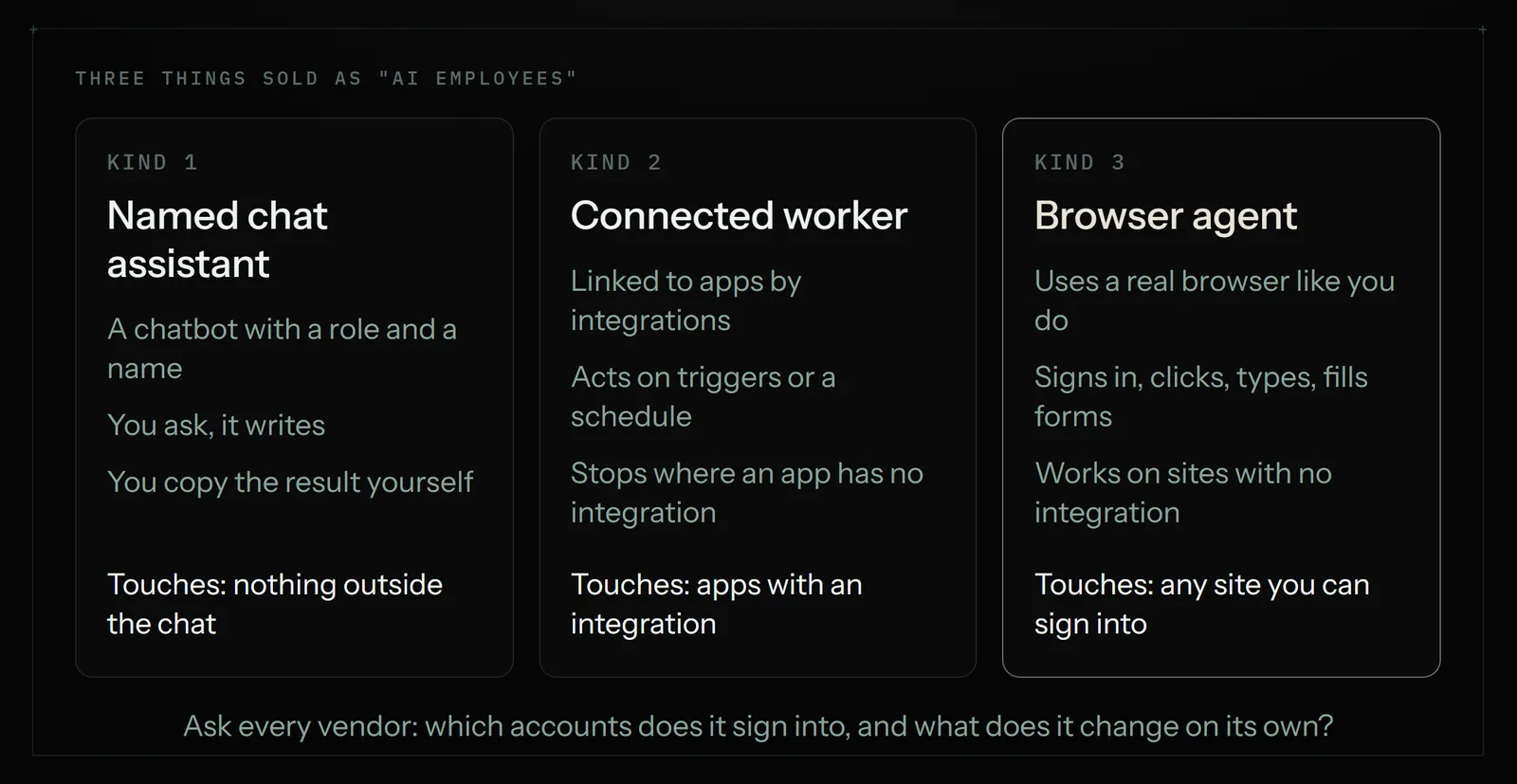
Strip away the avatars and you find three kinds of product under the same label. They differ in one thing that matters more than any other: what the software can touch.
- Named chat assistants. A chatbot given a role, a name and a set of instructions: "your social media manager", "your copywriter". You talk to it, it writes. Useful for drafts and ideas. It doesn't log into anything, and nothing happens unless you copy its output somewhere.
- Connected workers. An assistant linked to your apps through integrations: email, calendar, CRM, Slack. It can read and act inside those apps, often on a trigger ("when a new lead arrives, reply and add them to the sheet"). Good when every app in the job has an integration.
- Browser agents. Software that uses a real web browser the way you do: opens sites, signs in, clicks, types, fills forms, downloads and uploads. It can work on websites with no integration at all, such as a supplier portal, a marketplace dashboard or a government form.
Most products marketed as AI employees today are the first or second kind. Some combine two. When a vendor says its AI employee "handles your marketing", ask the plain question: which accounts does it sign into, and what does it change there on its own?
An AI employee vs a hire, side by side
The comparison owners make in their heads is "this software or a part-time person?" Here is how the two line up on the things that decide it.
| AI employee (software) | Part-time hire or VA | |
|---|---|---|
| Monthly cost | About $30 to $100 for one owner's plans; usage limits apply | About $1,730 in wages for 20 hours a week at $20 an hour, before payroll taxes; $10 to $39 an hour for a VA |
| Starts work | Same day | Weeks: posting, interviews, training |
| Hours | Runs on a schedule, including nights and weekends | Agreed hours, holidays, sick days |
| Best at | The same online steps, done the same way every time | Phone calls, customers, judgment, anything new |
| Weak at | Ambiguity, taste, relationships, anything off-screen | Repetitive copying at 6am every day |
| Mistakes | Confident errors if instructions are vague; needs checks | Human errors; can tell you when something looks wrong |
| Who is accountable | You, always | Shared, under an employment or contractor agreement |
| Paperwork | A subscription | Payroll, tax forms, contracts, possibly benefits |
The hire side of that table is not a straw man. The US Bureau of Labor Statistics put the average employer cost for a private-industry worker at $46.89 per hour worked in June 2026: $32.82 in wages and $14.07 in benefits. At 40 hours a week that is roughly $8,100 a month. Most small businesses aren't weighing a full-time hire against software, though. They are weighing ten spare hours a week, which is where both a part-timer and software start to make sense. We compared those two in more detail in virtual assistant vs AI agent.
What AI employees cost in 2026
Prices in this category move often, and several vendors meter by credits, so the headline number is a floor. These are list prices from each vendor's own pricing page, checked on 30 October 2026.
| Product | Kind | Price | How usage is limited |
|---|---|---|---|
| Sintra | Role-based assistants (12 roles, from social media to support) | $39 a month per helper, or the bundle listed at $97 a month and discounted on its page | Monthly credits |
| Lindy | Connected worker with computer use | From $29.99 per user a month; $50 of free credits for 7 days | 3,000 credits a month on the entry plan; top-ups $10 per 1,000 |
| ChatGPT Plus | General chat assistant | $20 a month for one person | Message limits |
| Astarii | Browser agent with app connections | Pro $29.99, Max $49.99, Ultra $99.99 a month; 3 free runs, no card | Minutes of run time; Pro includes 900 cloud plus 800 browser minutes |
Two things to check before you compare these numbers. First, what one credit or minute buys: a ten-second reply and a twenty-minute portal job are very different units. Second, what happens when you run out. Some products stop until the next cycle, others charge top-ups. Astarii counts a run's real length, rounded up to the minute, resets pools on the 1st, and sells 250 extra cloud minutes for $9.99. Full details are on the pricing page.
Jobs an AI employee does well
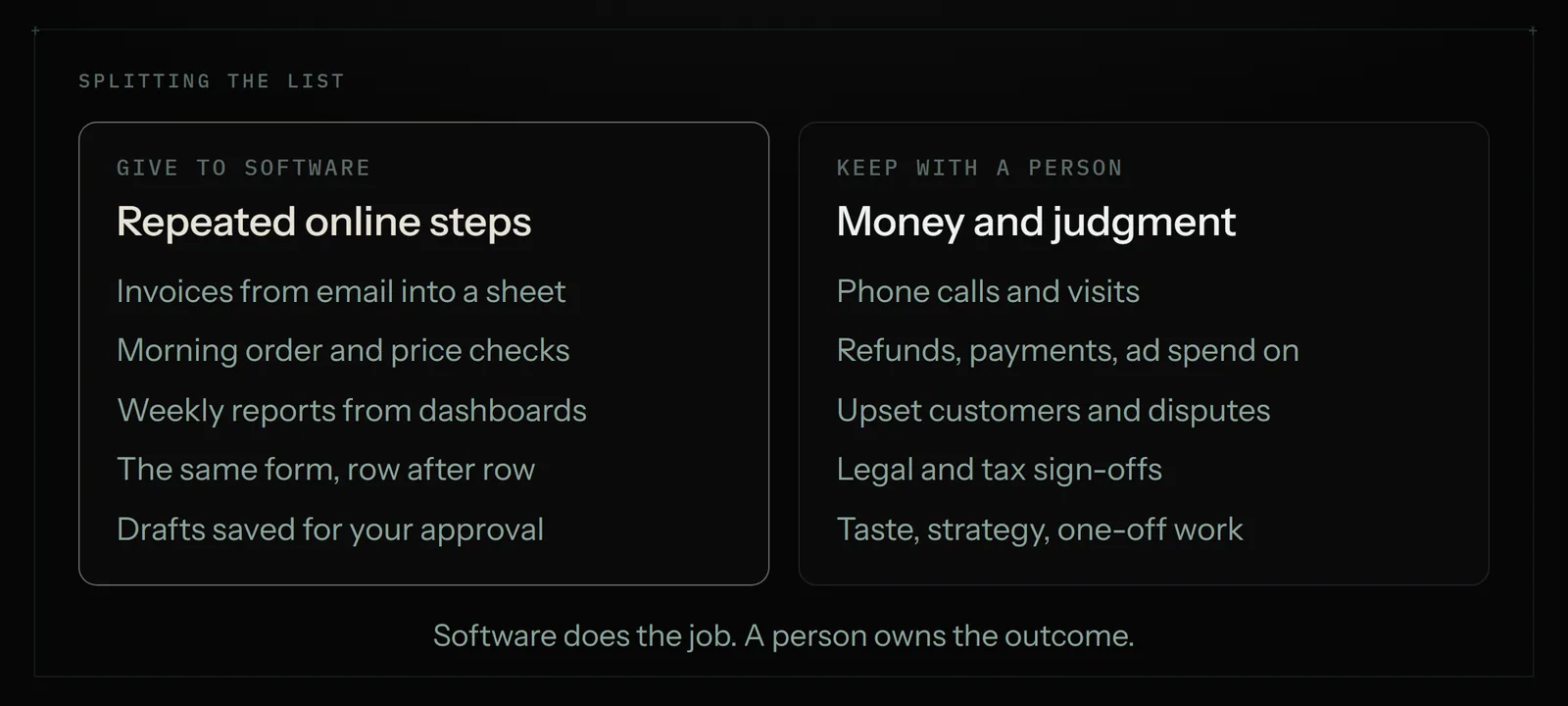
The pattern is the same across every product: repeated, rule-based, online, and checkable. If you can write the job as instructions a careful temp could follow on day one, software can probably do it. Good first jobs:
- Moving numbers between places. Copying this week's invoices from email into a sheet, or orders from a marketplace into your tracker. We walked through one in invoices from Gmail into a Google Sheet.
- Checking things on a schedule. A morning look at new orders, competitor prices every weekday at 7:30, a supplier portal for shipping status.
- Reports from sites you log into. Pulling the same figures from three dashboards into one email every Monday.
- Filling the same form many times. One row of a sheet becomes one form submission, row after row.
- First drafts. Replies to common questions, product descriptions, ad copy, saved as drafts for you to approve.
- Ongoing small tasks with memory. Applying to jobs or contacting leads without ever repeating one.
Each of these has a clear finish line and a result you can look at in a minute. That last part matters: an AI employee you can't check is one you can't trust. If you are not sure which of your jobs qualify, the 30-minute repetitive task audit sorts them.
Jobs that still need a person
Being honest about this is what separates a useful AI employee from an expensive disappointment. Keep these for yourself or a human hire:
- Anything on the phone or in person. Customers calling, deliveries, site visits.
- Moving money. Refunds, payments, turning on ad spend. Let software prepare it; you press the button.
- Disputes and upset customers. They want a person, and a wrong word costs more than the hour saved.
- Legal, tax and compliance statements. Software can gather the documents. You sign.
- Taste and strategy. Which product to launch, what your brand sounds like, whether a deal is worth it.
- Brand-new, one-off work. If you'd need to explain it differently every time, it's faster to do it yourself.
A good rule: software does the job, a human owns the outcome. The products worth paying for are built around that, with approval steps before anything important changes.
How to "hire" one: a one-week trial
Treat it like a trial shift, not a purchase. One job, one week, and a written verdict at the end.
- Pick one job you did at least three times last week. Write down how long it took. That is your baseline.
- Write the instructions as you would for a temp. Which site, which account, what to copy, where to put it, what to do if something looks odd, and what to report back. Plain English is enough.
- Run it once while you watch. Check every row or field it touched. Fix the instructions where it guessed.
- Put it on a schedule. Daily or weekly, at the time you'd normally do it. On Astarii this is a line like "every weekday at 7:30"; see scheduling.
- Spot-check for five days. Read each report. Count the errors and the minutes you spent checking.
- Decide. Keep it if it saved more time than it cost you in checking and the errors were small and visible. Otherwise drop it, or give the job to a person.
If the trial fails, it usually fails on step 2. Vague instructions produce confident guesses. "Update the sheet" is vague; "add one row per new invoice to the Invoices tab, skip any invoice number already there" is not.
Passwords, sign-in codes and approvals
An AI employee that signs into your accounts deserves the same caution as a new hire with your passwords. Ask any vendor four questions:
- Does the AI see my passwords? On Astarii, saved passwords are encrypted in your browser before they are stored and are never shown to the AI.
- What happens when a site sends a sign-in code? An Astari pauses and asks you, then carries on from where it stopped.
- Can it change live things without asking? The Astarii Etsy Manager proposes every change to your live shop and makes it only when you approve. The Google Ads Manager creates campaigns paused, so nothing spends until you turn it on.
- Will it repeat work? Task memory means a scheduled Astari never does the same item twice, such as re-applying to a job or re-emailing a lead.
If a product can't answer these clearly, give it only read-only jobs until it can.
Where Astarii fits, and where it doesn't
We call ours Astarii (one is an Astari) rather than employees, because they don't replace a person. An Astari works in a real browser: it opens websites, signs in, fills in forms, sends emails, updates spreadsheets and reports what it did. You describe the job in plain English, or show it once. It runs in the cloud with your laptop closed, in your own Chrome or Brave through the extension, or on your Windows PC through the desktop app. It connects to Gmail or Outlook and Google Sheets, Docs, Calendar and Drive, and several Astarii can hand work to each other as a team. If you have a ChatGPT plan, it can think with that.
There are ready-made Astarii for an Etsy shop, Google Ads, job hunting, X and Reddit, product launches and directories, and inbox-plus-spreadsheet work. See them on the apps page.
Where something else fits better:
- You need writing help, not work done. A chat assistant such as ChatGPT is cheaper. We covered this in ChatGPT for small business.
- Every app in the job has an integration and the job is pure rules. A connector tool such as Zapier is faster and cheaper per run.
- The job involves phone calls, customers or judgment. Hire a person or a VA.
- You need many teammates sharing one assistant across a company's tools. Team-oriented products such as Lindy are built around per-seat workspaces.
The bottom line
An "AI employee" is a subscription that does a defined online job on a schedule. Judged that way, the best ones are good value: tens of dollars a month for hours of repetitive work you no longer do. Judged as a replacement for a person, every one of them disappoints. Start with one boring, repeated job, give it a one-week trial, and keep the decisions for yourself. You can try it on Astarii with 3 free runs and no card; see the plans, or read your first Astari to set one up.
Say it to an Astari
These are instructions you can give an Astari, word for word. It does the work in a browser, on a schedule if you want one, and asks you before anything goes live.
Questions
What is an AI employee?
An AI employee is software given a role and a set of jobs, such as drafting replies, copying invoices into a sheet or checking orders each morning. Some are chat assistants with a name, some connect to your apps, and some use a real browser to sign into sites. None of them is a person.
Can an AI employee replace a human employee?
Not for a whole role. It can take over repeated online tasks inside a role, such as data entry, scheduled checks and first drafts. Phone calls, customers, money decisions and judgment calls still need a person, and you stay accountable for what the software does.
How much does an AI employee cost?
Most plans for one owner cost about $30 to $100 a month, usually with credit or minute limits. On 30 October 2026, Lindy started at $29.99 per user a month, Sintra listed $39 per helper, and Astarii plans were $29.99, $49.99 and $99.99 a month.
Is an AI employee cheaper than a virtual assistant?
For repeated online steps, yes: a subscription costs less than a few hours of a VA's time each month. For phone work, customer care and anything that needs judgment, a virtual assistant is the better buy. Many small businesses use both and split the list.
What jobs can I give an AI employee first?
Jobs you did at least three times last week, online, with a clear finish line: copying invoices or orders into a sheet, a morning order check, competitor prices on a schedule, weekly reports from dashboards you log into, or the same web form filled from rows in a sheet.
Is it safe to give an AI employee my passwords?
Ask how passwords are stored before you do. On Astarii, saved passwords are encrypted in your browser before they are stored and are never shown to the AI, and an Astari pauses to ask you when a site sends a sign-in code.
Will an AI employee change things without asking me?
It depends on the product. The Astarii Etsy Manager proposes every change to your live shop and makes it only after you approve, and the Google Ads Manager creates campaigns paused so nothing spends until you turn it on. Check this for any product before giving it write access.
Do I need to code to set up an AI employee?
Not for most products in this category. With Astarii you describe the job in plain English, or show it once, then pick a schedule. You can try it with 3 free runs of up to 15 minutes each and no card.
filed under AI agents explained