Lindy and Manus Alternatives for Small Business Work (Prices Checked November 2026)
Lindy is a teammate for Slack, inbox and meetings. Manus makes finished research, slides and sites. If neither fits, your job is probably a different shape. Here is what each costs this week and what to use instead.

The best Lindy or Manus alternative depends on the job. For one-off research and writing, ChatGPT or Claude at about $20 a month. For rules between apps, Zapier from $19.99. For workflows a team builds, Gumloop at $37. For repeated work on websites you sign into, Astarii from $29.99 a month. Lindy bills per user; Manus Pro is $20.
People search for a Lindy alternative or a Manus alternative for one of three reasons: the credits ran out faster than expected, the per-seat bill grew, or the tool turned out to be built for a different kind of work. The third reason is the most common, and it is the one a list of twenty names does not help with.
This guide is for a small business: an owner, maybe two or three people, with repeated online work to hand off. It says what Lindy and Manus are each built for, what their own pricing pages showed on 16 November 2026, and which alternative fits which job. Astarii, which we make, is one of the options. It is a browser agent you brief in plain English, and it is not the right pick for every reader here; we say where. If agents are new to you, start with the guide to AI agents for small business.
What Lindy and Manus are built for
They get listed together, but they are different products.
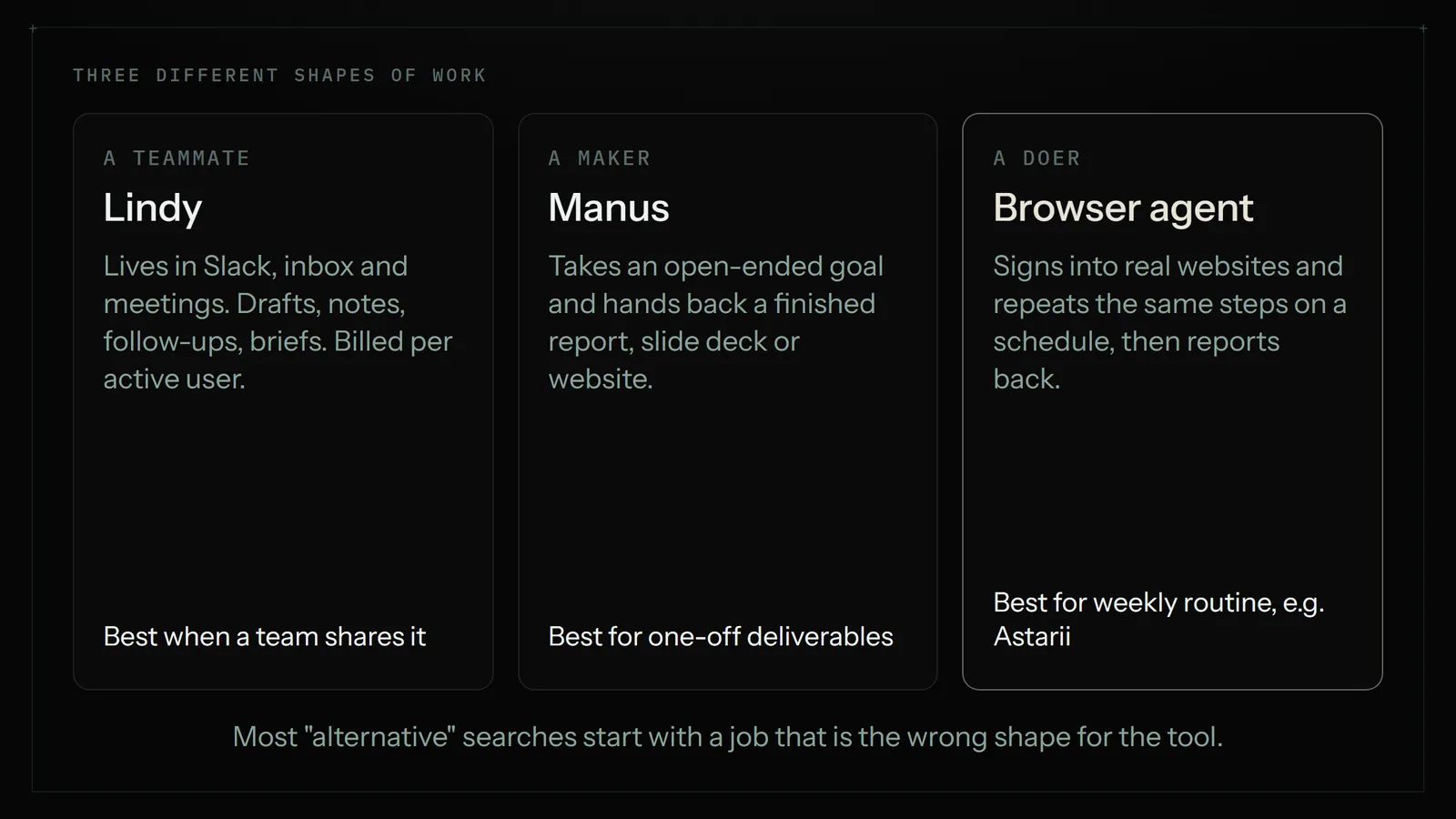
Lindy describes itself as a teammate. Its pricing page lists a Slack-native assistant that works in threads and mentions, inbox management, replies drafted in your voice, meeting recording, notes, scheduling and follow-up, daily briefs, scheduled routines and 3,000-plus integrations. It is sold per active user, with a pool of credits the whole workspace shares. The page also says anything with outside impact, such as sending an email or updating a ticket, waits for approval.
Manus is a general agent you hand an open-ended task. Its pricing page leads with research, websites and slides, plus "Wide Research across hundreds of sources", image and video generation, and custom domains for the websites it builds. You give it a goal, it works in its own cloud workspace and hands back a finished thing: a report, a deck, a site. It also has scheduled "automations": 2 on the free plan, 20 on Pro.
So Lindy is strongest when the work is communication inside a team, and Manus is strongest when the work is a one-off deliverable. Neither description is a criticism. The trouble starts when you buy one for the other's job, or for a third job: the same steps, on the same websites behind a login, every weekday.
What they cost on 16 November 2026
We read both vendors' pricing pages on the day of writing. Prices are US dollars.
Lindy
Lindy has a free start: $50 in credits that last 7 days. After that there is one paid plan, Team, billed for every active user in the workspace. Here is the odd part. On two loads of the same page on the same day we were shown two entry prices: $29.99 a month for 3,000 credits, and $49.99 a month for 5,000 credits. Both work out to about $10 per 1,000 credits, which is also the listed top-up rate, so the difference is the minimum you must buy per person, not the unit price. Check what the page shows you before you plan a budget.
The page gives a useful guide to usage: everyday asks (an answer, a summary, a drafted reply) take 2 to 250 credits, deeper work such as researching a competitor and writing the report takes 250 to 1,000, and big builds take 1,000 to 2,500. Monthly credits do not roll over. If the pool runs out, Lindy pauses instead of billing you more, which is a fair design.
Manus
Manus has three plans on its page. Free is $0 with 300 credits a day on the lighter Manus 2.0 Lite model, 3 tasks at once and 2 automations. Pro is $20 a month, or $17 a month billed yearly, with 4,000 credits a month, the full Manus 2.0 and 2.0 Max models, 20 tasks at once and 20 automations. Max is $200 a month, or $167 billed yearly, with 40,000 credits and pay-as-you-go when credits run out. Team and enterprise plans are sold separately.
What the page does not say is how many credits a task costs. That depends on how long the agent works, so the only way to know is to run your real task on the free plan and look at what it used.
Both tools meter in credits that vary with how hard the job is. That is the main reason people go looking for alternatives: a fixed monthly price with a moving amount of work inside it is hard to plan around. Test with a real week, not a demo task.
Why small businesses look for an alternative
- Per-seat billing. Lindy bills every active user. At three people that is three seats, so $89.97 to $149.97 a month depending on which entry price you are shown. That is fine for a team that lives in Slack and meetings. It is a lot for a shop where one person wants one job done.
- Credits you cannot predict. A deep-work task on Lindy's own scale is 250 to 1,000 credits. On a 3,000-credit plan, that is somewhere between 3 and 12 of them a month. Manus does not publish a per-task figure at all.
- The work is repeated, not one-off. Manus is at its best producing something new. A job like "check five supplier portals every weekday and log the prices" is the same steps each time. You do not need a research engine for it; you need something that turns up on schedule and never does the same item twice.
- The work sits behind a login. Supplier portals, marketplace dashboards and booking systems mostly have no integration. A tool that leans on integrations cannot reach them, and a general agent has to be handed the sign-in each time unless it stores one safely.
- You do not use Slack. Much of Lindy's value arrives as a teammate in Slack threads. A two-person business that runs on email and a sheet pays for features it will not open.
The alternatives, by the job you have
For one-off research and writing: ChatGPT or Claude
If you came to Manus for reports, summaries and drafts, a general chat assistant covers most of it for about $20 a month on the personal paid plans (a third-party figure we carried from our 13 November check; confirm on the vendor's page). You will do more of the steering yourself, and it will not build and host a website for you the way Manus does. For most owners that is an acceptable trade. Our post on ChatGPT for small business covers where it runs out.
Pick it when: the output is words or analysis and you start each task by hand. Skip it when: the job needs to run on its own on sites you sign into.
For rules between apps: Zapier or Make
If you came to Lindy for "when this happens in one app, do that in another", a connector is cheaper and steadier. Zapier's page showed a free plan with 100 tasks a month and Professional from $19.99 a month when billed yearly. Its Team plan, from $69 a month, covers 25 users on one bill, which is a very different shape from per-seat pricing. Zapier also sells Agents as an add-on if you want AI steps on top. Our n8n vs Zapier vs Make comparison picks between the connectors.
Pick it when: every app in the job has an integration and the job is pure rules. Skip it when: one step happens on a website with no integration.
For AI workflows you want to see: Gumloop
Gumloop is a builder for agents and AI workflows. Its page listed Pro at $37 a month with 20,000 credits and unlimited seats, so a team of three pays once. It suits someone who likes seeing each step and will spend an afternoon learning the tool. The no-code agent builders post compares it with the other builders.
Pick it when: you want control over every step and one bill for the team. Skip it when: nobody on the team wants to maintain a workflow.
For repeated work on sites you sign into: Astarii
Astarii is a browser agent. An Astari opens websites, signs in with a saved login, fills in forms, sends emails, updates spreadsheets and reports what it did. You describe the job in plain English or show it once, then put it on a schedule: every weekday at 7:30, three times a day, every Friday. It runs in the cloud with your laptop closed, or in your own Chrome through the extension, and it connects directly to Gmail or Outlook, Google Sheets, Docs, Calendar and Drive.
Three things are relevant if you are leaving a credit-metered tool. First, it is metered in minutes of real run time, which you can time with a stopwatch on the first run. Second, task memory means a scheduled Astari does not do the same item twice: it will not re-email a lead or re-apply to a job. Third, the safety rules are fixed: saved passwords are encrypted in your browser and never shown to the AI, a run pauses and asks you when a site texts a code, the Etsy Manager proposes every change to the live shop for approval, and the Google Ads Manager creates everything paused.
Pricing: a free trial of 3 runs of up to 15 minutes each with no card, then Pro at $29.99 a month for 900 cloud minutes plus 800 browser minutes. Max is $49.99 and Ultra $99.99. Details are on the pricing page.
Pick it when: the job is the same steps on real websites, on a schedule. Skip it when: you want a meeting note-taker, a Slack teammate or a tool that designs slides and websites. Astarii does none of those, and Lindy and Manus do.
For calls and judgment: a virtual assistant
Some work people try to give Lindy or Manus belongs with a person: phone calls, unhappy customers, anything where the right answer depends on tone. A part-time virtual assistant handles that, and software handles the repetition around them. Our virtual assistant vs AI agent comparison has hourly rates and a way to split the list.
Side-by-side comparison
| Tool | Built for | Entry paid price | How it is metered | Free start |
|---|---|---|---|---|
| Lindy | A teammate in Slack, inbox and meetings | $29.99 or $49.99 per active user a month (both shown on 16 Nov) | Credits, pooled across the team | $50 in credits for 7 days |
| Manus | One-off research, websites, slides | $20 a month, $17 billed yearly | Credits (4,000 a month on Pro) | 300 credits a day, lighter model |
| ChatGPT or Claude | Writing, reading, analysis you steer | About $20 a month (third-party figure) | Usage limits per plan | Free tiers |
| Zapier | Rules between apps with integrations | From $19.99 a month billed yearly | Tasks | 100 tasks a month |
| Gumloop | AI workflows you build and see | $37 a month, unlimited seats | Credits (20,000 a month) | See vendor page |
| Astarii | Repeated jobs on sites you sign into | $29.99 a month | Minutes of run time (900 cloud plus 800 browser) | 3 runs of up to 15 minutes, no card |
Credits, tasks or minutes: why the meter matters
The price on the page tells you less than the unit behind it. Three units are in play here.
Credits (Lindy, Manus, Gumloop) scale with how much thinking and how many steps a job takes. They are fair to the vendor and hard for you to forecast. The same instruction can cost different amounts on different days.
Tasks (Zapier) count steps. They are predictable for simple rules, and Zapier's page notes that AI steps and some connectors can use tasks at different rates.
Minutes (Astarii) count how long a run really took, rounded up to the minute. A slow website costs you more minutes, so it is not perfect either, but you can measure it once and multiply.
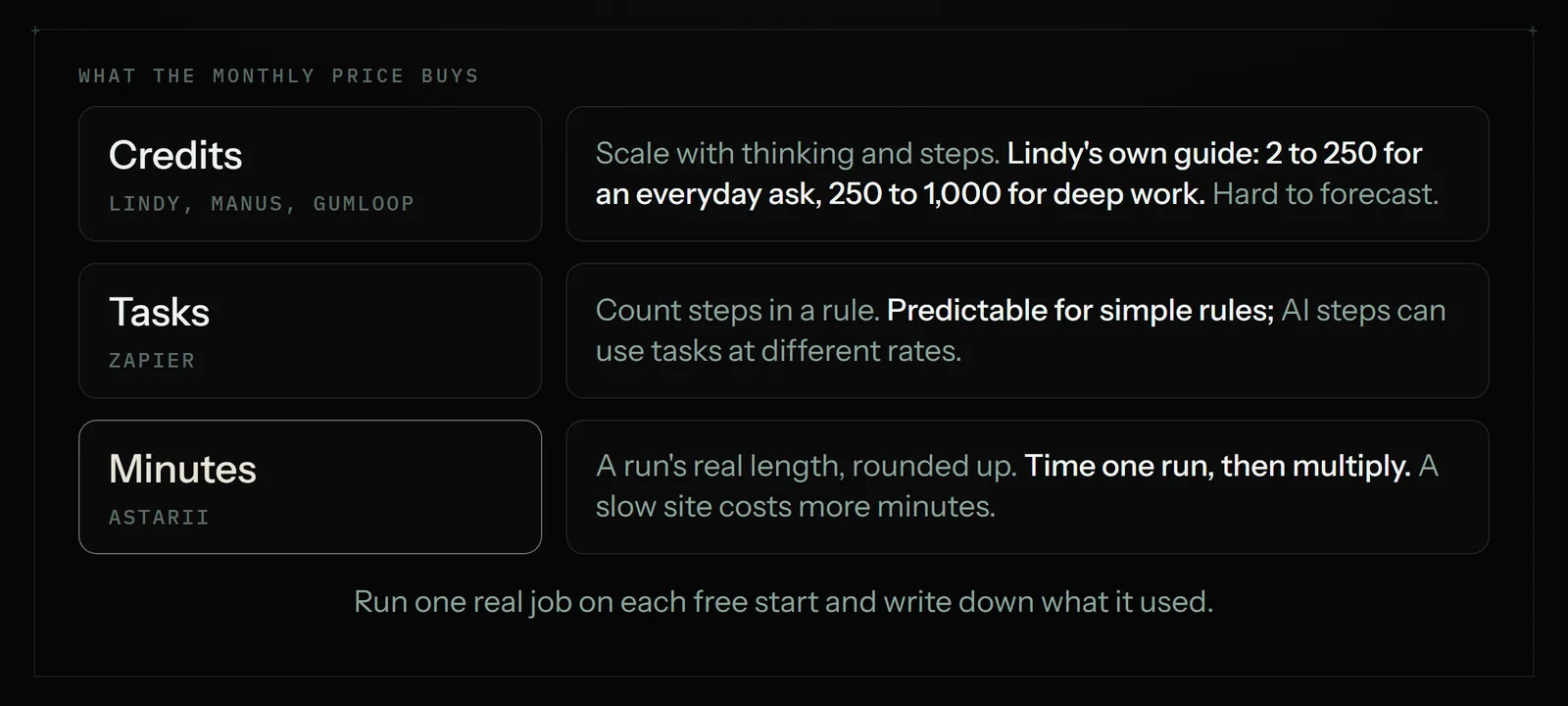
Here is an illustrative sum, not a benchmark. Say a weekday price check takes an Astari 6 minutes. Over 22 working days that is 132 minutes, out of 900 cloud minutes on Pro. On a credit tool you would run the same job for a week on the free allowance, read the usage page and multiply by four. Do that before paying anyone, us included.
Worked example: a three-person plant shop
Take a plant shop with an owner and two part-timers. This is a made-up business to show the reasoning. Their list:
- Every weekday, check two wholesale nursery portals for stock and price changes, and log them in a sheet.
- Every Friday, pull the week's supplier invoices out of Gmail into the bookkeeping sheet.
- Once a quarter, research what three local competitors are charging for delivery and write it up.
- Answer customers who phone about plant care.
Jobs 1 and 2 are repeated, scheduled and partly behind logins. That is browser-agent work; a Lindy seat for each of three people would be paying for meeting and Slack features the shop does not use. Job 3 is a one-off deliverable four times a year: Manus on its free plan, or a chat assistant, does it well, and a paid plan is hard to justify for four reports. Job 4 stays with people.
The shop ends up with one agent subscription for the repeated jobs, a free or $20 tool for the quarterly research, and the phone still answered by a person. That mix, not one winner, is the usual result. The round-up of AI agents by job goes through more of these splits.
When to stay with Lindy or Manus
Switching has a cost, so here is when not to.
- Stay with Lindy if your team already works in Slack, most of the load is email triage, meeting prep and follow-up, and several people draw on it. Pooled credits and built-in approvals suit that well, and its enterprise plan lists HIPAA compliance and SSO, which Astarii's product facts do not list.
- Stay with Manus if what you value is the finished artefact: a researched report with sources, a slide deck, a launch site on your own domain. A browser agent that fills forms is not a replacement for that.
- Stay with either if your monthly usage is steady and inside the plan. The complaint about credits is unpredictability. If yours are predictable, there is nothing to fix.
How to choose in 20 minutes
- Write down the one job you most want gone. One sentence, with when it happens and what "done" looks like.
- Ask if it repeats. One-off deliverable: Manus or a chat assistant. Repeats on a schedule: keep going.
- Ask where it happens. Inside Slack, inbox and meetings: Lindy. Between apps that all have integrations: Zapier or Make. On websites you sign into: a browser agent.
- Count the people. If three people will use it, multiply any per-seat price by three before comparing.
- Run it free. Lindy's $50 in credits, Manus's daily credits, Zapier's 100 tasks and Astarii's 3 runs all let you try the real job. Note what one run used.
- Keep approvals on. Whatever you choose, anything customers or money will see should wait for your yes for the first month. Our post on letting an agent log into your accounts covers the rest.
The bottom line
Lindy and Manus are good at what they are built for: a teammate for a team's communication, and an agent that produces finished research, slides and sites. If you are looking for an alternative, the likely cause is that your job is a different shape. For rules between connected apps, use Zapier or Make. For words and analysis, a $20 chat assistant. For the same steps on real websites every week, a scheduled browser agent. Astarii's free trial is 3 runs with no card, so you can time your own job before deciding: start from your first Astari, or see the plans on the pricing page.
Say it to an Astari
These are instructions you can give an Astari, word for word. It does the work in a browser, on a schedule if you want one, and asks you before anything goes live.
Questions
What is the best alternative to Lindy AI for a small business?
It depends on what you used Lindy for. For rules between apps, Zapier (from $19.99 a month billed yearly) or Make. For AI workflows on one team bill, Gumloop at $37 a month. For repeated work on websites you sign into, Astarii from $29.99 a month. For meeting notes and a Slack teammate, Lindy is still the better fit.
What is the best alternative to Manus AI?
For research, summaries and drafts, a chat assistant such as ChatGPT or Claude at about $20 a month covers most of it. For the same online steps on a schedule behind a login, a browser agent such as Astarii fits better. For finished slide decks and websites built from one prompt, Manus remains the stronger tool.
How much does Lindy cost in November 2026?
Lindy's pricing page on 16 November 2026 offered $50 in free credits lasting 7 days, then a Team plan billed per active user. On two loads the same day we saw two entry prices: $29.99 a month for 3,000 credits and $49.99 a month for 5,000 credits. Top-ups were $10 per 1,000 credits.
How much does Manus cost in November 2026?
Manus's pricing page on 16 November 2026 listed Free at $0 with 300 credits a day, Pro at $20 a month ($17 billed yearly) with 4,000 credits a month, and Max at $200 a month ($167 billed yearly) with 40,000 credits. The page does not say how many credits a task uses.
Is there a free alternative to Lindy or Manus?
Several tools have a free start. Manus itself has a free plan with 300 credits a day. Zapier has a free plan with 100 tasks a month. Lindy gives $50 in credits for 7 days. Astarii has a free trial of 3 runs of up to 15 minutes each, with no card, and it does not refill.
Why do Lindy and Manus credits run out so fast?
Credits scale with how much work a job takes. Lindy's own guide says an everyday ask uses 2 to 250 credits and deeper work 250 to 1,000, so a 3,000-credit plan can be 3 to 12 deep tasks. Manus does not publish a per-task figure. Run a real week on the free allowance before you buy.
Can an alternative work on websites that need a login?
A browser agent can. Astarii signs in with a saved login, and saved passwords are encrypted in your browser and never shown to the AI. If a site texts a code, the run pauses and asks you, then carries on. Connector tools such as Zapier only work where an app has an integration.
Does Astarii replace Lindy or Manus completely?
No. Astarii does repeated online work in a real browser: sign in, fill forms, send emails, update sheets, on a schedule. It is not a meeting note-taker or a Slack teammate like Lindy, and it does not design slide decks or build websites like Manus. Many small businesses use two tools.
filed under AI agents explained