AI Agent vs Chatbot: What's the Difference for a Small Business?
Half the products called "AI agents" are chatbots with a new label. Here is the real difference, which small-business jobs suit each, what they cost, and when you need neither.

A chatbot answers: it writes drafts, replies and summaries, and you do the clicking. An AI agent acts: it signs into sites, fills forms, sends emails and updates sheets, often on a schedule, then reports back. Chatbots cost about $20 a month; support bots charge per answer; agents such as Astarii start at $29.99 a month. Many small businesses use both.
Every software company now calls its product an "AI agent", including plenty of products that are chatbots with a new label. For a small business owner that makes buying hard: you can't tell from the homepage whether the thing will answer a question or do the job.
The difference is simple once you see it. A chatbot gives you words. An AI agent takes steps: it opens sites, signs in, clicks, fills forms, updates a sheet, and tells you what it did. This guide explains the difference in plain terms, shows where each one earns its keep in a small business, compares prices, and says honestly when you don't need an agent at all. If you want to see what setting up an agent looks like, here is how a first Astari is set up. For the wider picture, start with the guide to AI agents for small business.
The difference in one sentence
A chatbot ends with an answer. An AI agent ends with the job done.
Take one ordinary request: "chase the unpaid invoices". Give it to a chatbot such as ChatGPT and you get three well-written reminder emails. Then you open your invoicing site, check who's overdue, paste each email, send it, and note it somewhere. The chatbot did the writing; you did the work.
Give the same request to an AI agent and it opens the invoicing site, signs in, finds the overdue invoices, sends the reminders (or drafts them for your approval), logs what it sent in a sheet and messages you a summary. The writing is the same quality. The difference is who does the clicking.
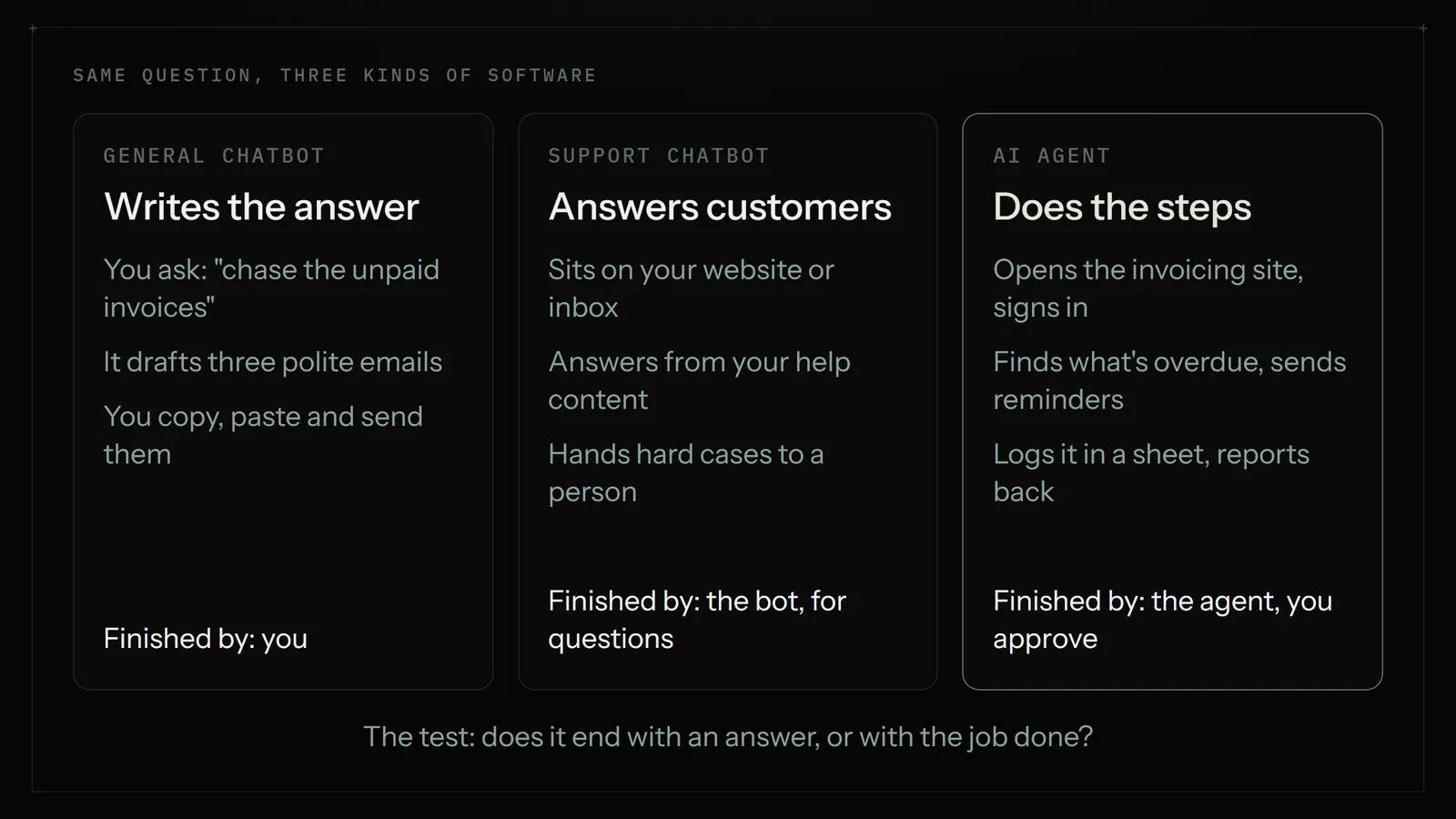
Three kinds of software sold under these names
The vendor labels overlap, so it helps to sort products by what they actually do rather than what they're called.
1. General chatbots
ChatGPT, Claude, Gemini and similar assistants. You type, they answer. They are very good at writing, summarising, explaining, analysing a spreadsheet you upload and helping you think. Most now search the web and some can take a few actions, but the normal loop is still: you ask, it replies, you act on the reply. For one person they cost about $20 a month; ChatGPT Plus is $20.
2. Support chatbots
Tools such as Intercom's Fin, Tidio's Lyro and Chatbase sit on your website or inbox and answer customers from your help articles, policies and product pages. Many of them now call themselves "AI agents", and some can take narrow actions inside the support system, such as looking up an order status or handing the chat to a person. Their job is still the conversation with your customer. They're priced by usage: Intercom charges $0.99 per Fin outcome, and Chatbase starts at $40 a month for 700 message credits.
3. AI agents that work on websites and apps
These take a goal and carry out the steps. Some connect to apps through integrations; browser agents such as Astarii use a real browser the way you do, so they also work on sites that have no integration: supplier portals, marketplace dashboards, government forms. You describe the job in plain English, the agent does it, often on a schedule, and reports back. Astarii plans are $29.99, $49.99 or $99.99 a month, metered in minutes of run time.
Side by side
| General chatbot | Support chatbot | AI agent (browser) | |
|---|---|---|---|
| What it produces | Text: drafts, answers, summaries | Answers to your customers | Finished tasks plus a report |
| Who starts it | You, each time | A customer's message | You, or a schedule |
| What it can touch | The chat, files you upload | Your help content, support inbox | Sites and apps you give it access to |
| Works while you're away | No | Yes, for customer questions | Yes, on a schedule |
| Typical price | About $20 a month | Per message or per answer, e.g. $0.99 per outcome | Per run time or task, e.g. from $29.99 a month |
| Main risk | Confident wrong answers | Wrong answers to customers | A wrong action on a live account |
| Best for | Writing and thinking | Repeated customer questions | Repeated online chores |
Prices were read on the vendors' own pages on 9 November 2026 and change often.
What makes something an agent (and what doesn't)
Marketing has stretched the word, so here are the four things that separate a real agent from a chatbot with a new name.
- It acts outside the chat. It opens a website, clicks, types, uploads a file, sends an email or updates a spreadsheet. If every result lands back in the chat window for you to copy, it's a chatbot.
- It works through several steps on its own. Sign in, search, open each result, compare, record. It decides the next step from what it sees on the page rather than following a fixed script.
- It can run without you starting it. Every weekday at 7:30, every Friday at 4pm. An agent you have to prompt by hand every time is only half the value.
- It reports back and remembers. It tells you what it did and what it skipped, and on the next run it doesn't redo work already done. Astarii's task memory, for example, means a scheduled Astari never emails the same lead twice.
What does not make something an agent: a friendly name, an avatar, "learns from your data", or a chatbot that can look up an order number. Those can be useful, but they don't take the work off your list.
Which one fits which small-business job
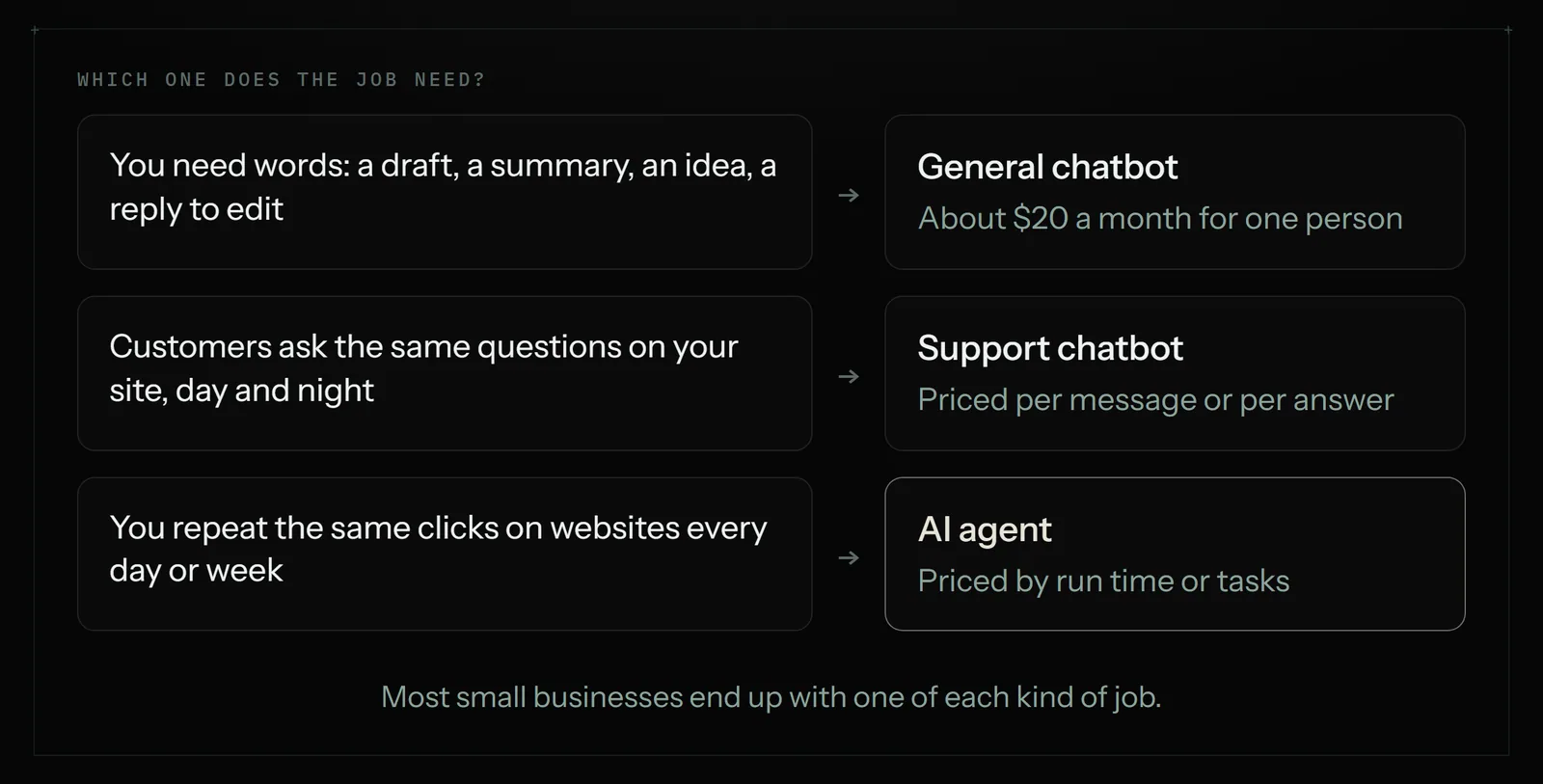
Here's how common jobs split in a small business.
Give these to a general chatbot
- Writing a product description, a newsletter or a tricky email to a customer.
- Summarising a long contract or a supplier's terms before you read the key parts yourself.
- Making sense of an export: "which products sold best last quarter?" from a CSV you upload.
- Planning: pricing ideas, a launch checklist, a list of questions for your accountant.
We cover this in more depth in ChatGPT for small business.
Give these to a support chatbot
- "Where's my order?", "Do you ship to Canada?", "What's your return policy?" on your website, at any hour.
- Collecting a customer's details before a person picks up the conversation.
A support chatbot is worth it once the same questions arrive every day and your help content answers them. If you get five customer messages a week, answer them yourself.
Give these to an AI agent
- Every Friday, copying this week's invoices from Gmail into a Google Sheet.
- Each morning, checking new orders on Etsy and listing anything unusual.
- Every weekday, checking five competitors' prices and logging changes.
- Sending unpaid invoice reminders on a fixed schedule.
- Filling the same web form from rows in a spreadsheet.
- Collecting numbers from three dashboards you log into and emailing yourself a weekly summary.
The pattern: you did it at least three times last week, it happens on websites or in your inbox, and it has a clear finish line. AI agent examples has 25 more.
A worked example: one Monday at a flower shop
Say you run a small flower shop with a website and an Etsy shop. On a typical Monday:
- You need a Mother's Day email. A chatbot drafts it in two minutes; you edit and send it from your email tool.
- Customers ask on your site whether you deliver to the next town and what time cut-off is. A support chatbot can answer those from your delivery page, if enough people ask to justify the cost.
- You copy weekend orders from Etsy and your website into a spreadsheet, check the wholesaler's portal for stem prices, and chase two late invoices from corporate customers. That's about an hour of clicking, every week. An agent does that on a schedule and sends you a summary at 8am.
Notice that the jobs don't compete. Most owners who use an agent still use a chatbot for writing. The question isn't "which one?" but "which jobs go where?".
When you don't need an agent
An agent costs more than a chatbot and takes longer to set up, so be honest about whether you need one.
- The work is mostly writing. A $20 chatbot is enough.
- Every app in the job has an integration and the rules never change. "When a form is submitted, add a row and send a Slack message" is cheaper and faster in Zapier or Make. We compare them in Zapier vs an AI browser agent.
- The job happens once. Set-up time beats the saving. Do it by hand.
- It involves moving money, legal sign-offs or upset customers. Keep those yourself, whichever tool you own.
And when you don't need a chatbot: if you already have one through work, or the jobs on your list are clicks rather than words, skip it.
The risks are different too
A chatbot's main risk is a confident wrong answer. You catch it because you read what it wrote before you use it.
An agent's risk is a wrong action: a changed price, a sent email, a form submitted with the wrong row. That's why the safety design matters more than the model. Look for:
- Approvals before live changes. The Astarii Etsy Manager proposes every change to your live shop and makes it only when you approve. The Google Ads Manager creates campaigns paused, so nothing spends until you turn it on.
- Pauses for sign-in codes. When a site texts a code or something needs a decision, an Astari stops and asks you, then carries on from where it stopped.
- Passwords kept from the AI. On Astarii, saved passwords are encrypted in your browser before they're stored and are never shown to the AI.
- Limited access. Give an agent only the accounts the job needs. Keep your bank and main email away from it. More in is it safe to let an AI agent log into your accounts?
What each costs a small business
Rough monthly costs for one owner, as listed on 9 November 2026:
- General chatbot: free tiers exist; ChatGPT Plus is $20 a month.
- Support chatbot: Chatbase Hobby is $40 a month ($32 billed yearly) for 700 message credits. Intercom's Fin is $0.99 per outcome on top of seats from $29 a month, with a monthly minimum when used outside Intercom's own help desk. Tidio sells its Lyro AI agent separately from its live chat plans, priced by AI conversations.
- Browser agent: Astarii Pro is $29.99 a month with 900 cloud minutes plus 800 browser minutes; Max is $49.99 and Ultra $99.99. You can try it with 3 free runs of up to 15 minutes each, no card. See pricing.
To judge an agent's value, count the minutes. If a Friday invoice job takes you 30 minutes by hand and an agent does it in ten minutes of run time, four runs a month use 40 of your minutes and give you two hours back.
How to try an agent this week
- Write down three online jobs you repeated last week, with roughly how long each took.
- Pick the one with the clearest finish line, such as "invoices into the sheet".
- Describe it in plain English, as you would to a new assistant: which site, what to copy, where to put it, what to skip.
- Run it once while you watch. Fix the instructions where it guessed.
- Put it on a schedule. Our scheduling guide covers times like every weekday at 7:30.
Keep using your chatbot for writing. Ready to try the other half? Set up your first Astari with 3 free runs, or compare plans on the pricing page.
Say it to an Astari
These are instructions you can give an Astari, word for word. It does the work in a browser, on a schedule if you want one, and asks you before anything goes live.
Questions
What is the difference between an AI agent and a chatbot?
A chatbot produces words: answers, drafts and summaries that you then act on yourself. An AI agent takes the steps: it opens websites, signs in, fills forms, sends emails and updates spreadsheets, then reports what it did. A chatbot ends with an answer; an agent ends with the job done.
Is ChatGPT a chatbot or an AI agent?
Mostly a chatbot. You ask, it answers, and you act on the answer. It can search the web and take some actions, but for a repeated job on sites behind a login, on a schedule, a dedicated agent fits better. Many owners use ChatGPT for writing and an agent for the clicking.
Do small businesses need an AI agent or a chatbot?
It depends on the job. Writing and thinking suit a general chatbot. Repeated customer questions on your website suit a support chatbot. Repeated online chores, such as invoices into a sheet every Friday or a morning order check, suit an agent. Many small businesses end up with a chatbot and an agent.
How much does an AI agent cost compared with a chatbot?
On 9 November 2026, ChatGPT Plus was $20 a month. Support chatbots charge by use: Chatbase from $40 a month, Intercom's Fin $0.99 per outcome. Astarii, a browser agent, costs $29.99, $49.99 or $99.99 a month, with 3 free runs of up to 15 minutes each and no card.
Can a chatbot work on a schedule?
Some general chatbots can run scheduled prompts that send you a message, and support chatbots answer customers whenever they write. Neither will sign into a supplier portal at 7:30 every weekday and update your sheet. That is what a scheduled agent does.
Is an AI agent riskier than a chatbot?
The risk is different. A chatbot can give a confident wrong answer, which you catch when you read it. An agent can take a wrong action on a live account. Choose one with approvals before live changes, pauses for sign-in codes, and passwords kept from the AI, and give it only the accounts the job needs.
Are customer support chatbots AI agents?
Many are now sold as AI agents. They answer customers from your help content and can take narrow actions inside the support system, such as checking an order status or handing over to a person. Their job is still the conversation, not your back-office chores.
Do I need to code to use an AI agent?
Not with most small-business agents. With Astarii you describe the job in plain English, or show it once, connect the accounts it needs and pick a schedule. Start with one job you repeated three times last week.
filed under AI agents explained